
D-Sub - F 05. 03 M F M F M F M F connector technical characteristics, including wiring method, contact conditions, working current, test voltage, contact resistance, insulation resistance, temperature range, heat deflection temperature, wiring method, insulation material, contact material, contact surface, performance level, metal shell, etc.
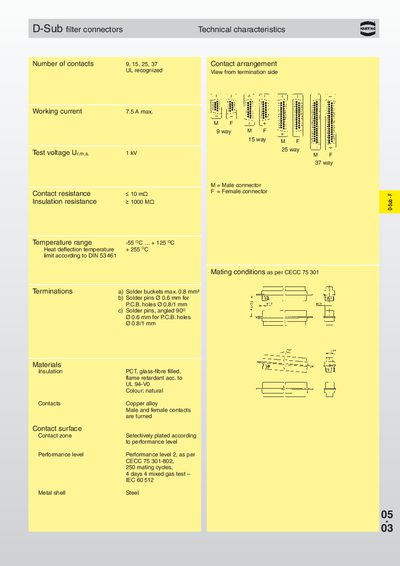
This document provides the technical characteristics of HARTING D-Sub filter connectors, including contact options, material details, and performance levels. It lists the number of contacts, current rating, voltage withstand, and environmental limits.
Key data such as insertion loss, attenuation versus frequency, and mating cycle durability are presented, along with part numbers for male and female variants. The sheet also includes dimensional drawings and identification markings.
| Number of contacts | 9, 15, 25, 37 |
|---|---|
| Maximum working current | 7.5 A |
| Insulation resistance | 1000 MΩ |
| Operating temperature range | -55 °C to +125 °C |
| Mating cycles | 250 cycles |
| Performance level | 2 |
The connectors are rated for a maximum working current of 7.5 A.
The specified operating range is –55 °C to +125 °C.
The connectors are rated for 250 mating cycles.