
The LTC ®1407/LTC1407A are 12-bit/14-bit, 3Msps ADCs with two 1.5Msps simultaneously sampled differential inputs
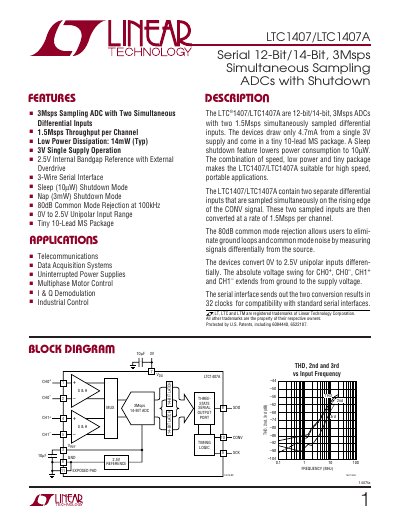
The LTC1407/LTC1407A are high‑speed, low‑power ADCs that provide two simultaneous differential inputs sampled at up to 1.5 Msps per channel (3 Msps total). They operate from a single 3 V supply, draw as little as 10 µW in sleep mode, and feature an internal 2.5 V reference.
Typical applications include telecommunications, data‑acquisition systems, uninterrupted power supplies, multiphase motor control, I&Q demodulation, and industrial control where high sampling rates and low power are required.
| Resolution | 12‑bit (LTC1407) / 14‑bit (LTC1407A) |
|---|---|
| Maximum Sampling Rate per Channel | 1.5 Msps |
| Power Dissipation (Active Mode) | 14 mW typ |
| Supply Voltage | 2.7 V – 3.6 V |
| Input Voltage Range | 0 V to 2.5 V unipolar |
| CMRR | 80 dB at 100 kHz |
| Sleep Mode Power | 10 µW |
| Package | 10‑lead MSOP (plastic) |
Each channel can sample up to 1.5 Msps, giving a total of 3 Msps for the device.
The typical active‑mode power dissipation is 14 mW.
It is supplied in a 10‑lead plastic MSOP (MS) package.
The device provides an 80 dB CMRR at 100 kHz.