
This is a design note about radio frequency identification (RFID) technology. It introduces a high performance RFID receiver, which uses direct conversion technology to demodulate an RF carrier directly to a baseband signal without an intermediate frequency down-conversion.
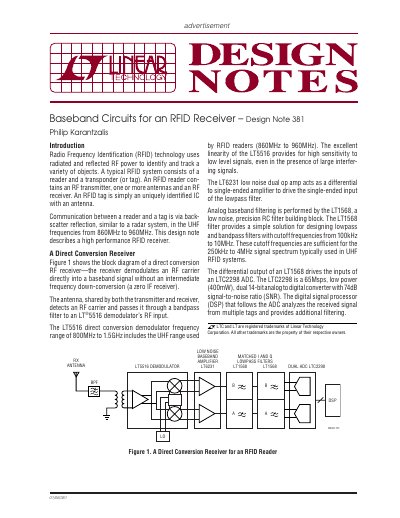
Radio Frequency Identification (RFID) systems use a reader and a tag to exchange data via back‑scatter at UHF frequencies (860 MHz‑960 MHz). The note describes a direct‑conversion receiver that demodulates the RF carrier directly to baseband without an intermediate frequency stage.
The baseband chain uses the LT5516 demodulator, an LT6231 low‑noise differential‑to‑single‑ended amplifier, LT1568 low‑noise RC filters, and an LTC2298 65 Msps ADC. The design achieves high sensitivity and linearity, with filter cut‑offs from 100 kHz to 10 MHz and a matched I/Q filter providing 34 dB stop‑band attenuation.
| LT5516 frequency range | 800 MHz to 1.5 GHz |
|---|---|
| LT1568 filter cutoff range | 100 kHz to 10 MHz |
| LTC2298 ADC sampling rate | 65 Msps |
| LTC2298 ADC resolution | 14‑bit |
| LTC2298 ADC SNR | 74 dB |
The LT5516 operates from 800 MHz to 1.5 GHz, covering the UHF RFID band of 860 MHz to 960 MHz.
The design uses the LTC2298 ADC, a 65 Msps, 14‑bit converter with 74 dB SNR and 400 mW power consumption.
The LT1568 provides low‑pass and band‑pass filters with cutoff frequencies from 100 kHz to 10 MHz.