
The LTC1625 is a synchronous step-down switching regulator controller that drives external N-Channel power MOSFETs using few external components. Current mode control with MOSFET VDS sensing eliminates the need for a sense resistor and improves efficiency. The frequency of a nominal 150kHz internal oscillator can be synchronized to an external clock over a 1.5:1 frequency range. Burst Mode operation at low load currents reduces switching losses and low dropout operation extends operating time in battery-powered systems. A forced continuous mode control pin can assist secondary winding regulation by disabling Burst Mode operation when the main output is lightly loaded. Fault protection is provided by foldback current limiting and an output overvoltage comparator. The LTC1625 is available in 16-Lead Narrow SSOP and SO Packages.
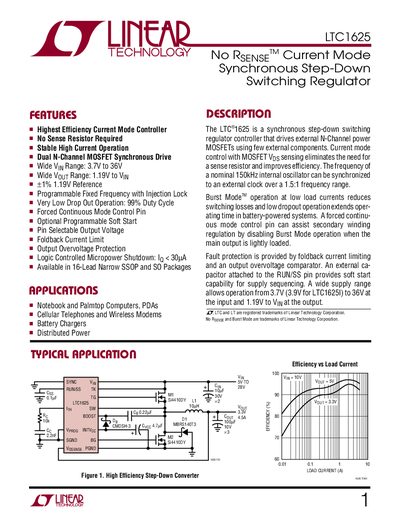
The LTC1625 is a No‑RSENSE current‑mode synchronous step‑down switching regulator that operates over a wide input voltage range and requires no external sense resistor. It offers high efficiency, programmable fixed‑frequency operation, and features such as foldback current limit, over‑voltage protection, and burst‑mode operation for low‑load conditions.
The document includes detailed electrical characteristics, pin descriptions, typical performance graphs, package dimensions, and a typical application circuit. It also explains the internal operation, synchronization options, and soft‑start behavior, making it useful for designers integrating the regulator into battery‑powered or distributed power systems.
| Input Voltage Range | 3.7 V to 36 V |
|---|---|
| Output Voltage Reference | 1.19 V |
| Oscillator Nominal Frequency | 150 kHz |
| Maximum Boost Supply Voltage | 42 V |
| Package Type | 16‑Lead Plastic SSOP (Narrow 0.150) |
The LTC1625 operates from 3.7 V up to 36 V input.
The output voltage is set by the Vprog pin: Vprog < 0.8 V selects 3.3 V, while Vprog > 3.5 V selects 5 V.
The internal oscillator runs at a nominal 150 kHz and can be synchronized up to about 225 kHz.
Pulling the RUN/SS pin low forces the controller into shutdown, turning off both MOSFETs.