
This datasheet introduces the features and characteristics of the low power, broadband down converting mixer LT5525, including frequency range, input IP3, conversion gain, LO-RF and LO-IF isolation, SSB noise figure, single-ended 50Ω RF and LO interface, integrated LO buffer, supply current, enable function, and package
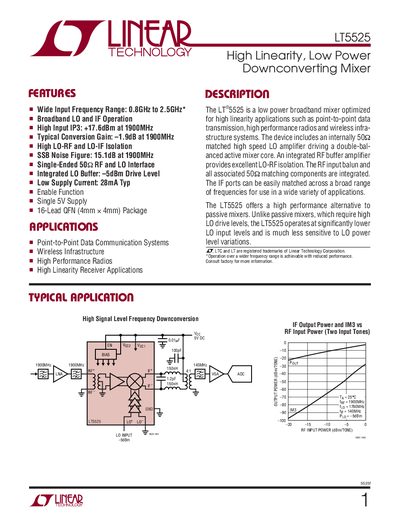
The LT5525 is a low‑power broadband mixer optimized for high‑linearity applications such as point‑to‑point data transmission, high‑performance radios and wireless infrastructure. It integrates a 50 Ω matched LO buffer, a double‑balanced active mixer core, and an RF buffer amplifier, providing excellent LO‑RF isolation and low LO drive requirements.
The device is offered in a 16‑lead 4 mm × 4 mm plastic QFN package and operates from a 3.6 V to 5 V supply with typical 28 mA current draw. Electrical characteristics include a typical conversion gain of –1.9 dB at 1900 MHz, SSB noise figure of 15.1 dB, and input frequency coverage from 0.8 GHz to 2.5 GHz.
| Input Frequency Range | 0.8 GHz – 2.5 GHz |
|---|---|
| LO Input Frequency Range | 500 MHz – 3 GHz |
| Typical Conversion Gain at 1900 MHz | -1.9 dB |
| Typical Supply Current | 28 mA (5 V) |
| Package | 16‑lead 4 mm × 4 mm plastic QFN |
| LO Input Power Range | -10 dBm to 0 dBm |
| SSB Noise Figure at 1900 MHz | 15.1 dB |
The LT5525 accepts input frequencies from 0.8 GHz to 2.5 GHz.
It is supplied in a 16‑lead 4 mm × 4 mm plastic QFN package.
Typical supply current is 28 mA when powered at 5 V.
The typical conversion gain at 1900 MHz is –1.9 dB.