
The M27C4001 is a 4Mbit EPROM with a supply voltage of 5V±10%, a read time delay of 35ns, low power consumption, an active current of 30mA, a standby current of 100µA, a programming voltage of 12.75V±0.25V, and a programming time of 100µs/word.
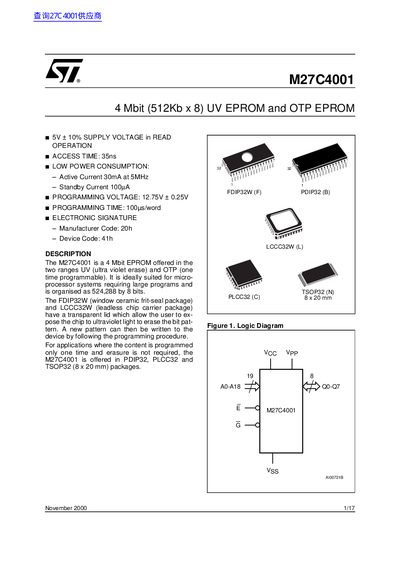
The M27C4001 is a 4 Mbit EPROM offered in UV (ultraviolet erase) and OTP (one‑time programmable) versions. It is organized as 524,288 × 8 bits and is supplied in several packages such as PDIP32, PLCC32, TSOP32, FDIP32W and LCCC32W.
The document provides absolute maximum ratings, operating modes, electrical characteristics, programming requirements and mechanical data for the device, along with system‑level recommendations for decoupling and standby operation.
| Memory capacity | 4 Mbit (524,288 × 8 bits) |
|---|---|
| Access time | 35 ns |
| Active current (read) | 30 mA at 5 MHz |
| Standby current | 100 µA |
| Programming voltage | 12.75 V + 0.25 V |
| Supply voltage (read) | SV + 10 % (≈5 V + 10 %) |
The device requires a programming voltage of 12.75 V plus 0.25 V.
The ambient operating temperature is specified from –40 °C to 125 °C.
In standby mode the device draws about 100 µA.