
This document introduces NCP101X series products. The series integrates a fixed frequency current mode controller and a 700 V MOSFET. It is housed in a PDIP-7, PDIP-7 Gull Wing, or SOT-223 package. It provides soft start, frequency jittering, short circuit protection, skip cycle, a maximum peak current setpoint and a Dynamic Self-Supply (no need for an auxiliary winding). The switching frequency is 65-100-130 kHz. When the current setpoint falls below a given value, e.g. the output power demand diminishes, the IC automatically enters the so-called skip-cycle mode and provides excellent efficiency at light loads. No acoustic noise takes place. Short-circuit detection takes place when the feedback signal fades away, e.g. in true short-circuit conditions or in broken Optocoupler cases. External disabling can be easily done either simply by pulling the feedback pin down or latching it to ground through an inexpensive SCR for complete latched-off.
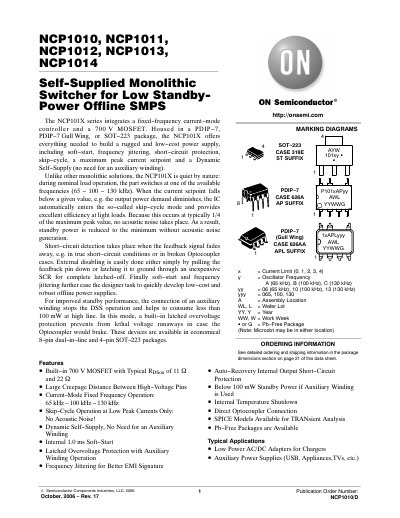
The NCP101X series combines a fixed‑frequency current‑mode controller with a 700 V MOSFET in a single monolithic package (PDIP‑7, PDIP‑7 Gull Wing, or SOT‑223). It offers features such as soft‑start, frequency jittering, skip‑cycle operation for ultra‑low standby power, and built‑in over‑voltage and short‑circuit protection. The devices operate at selectable frequencies of 65 kHz, 100 kHz or 130 kHz and automatically enter a quiet skip‑cycle mode at low load currents.
Technical data include typical RDS(on) values of 11‑22 mΩ, peak drain currents up to 450 mA, and standby power below 100 mW when an auxiliary winding is used. The datasheet provides pin‑out diagrams, electrical characteristics, maximum ratings, typical performance curves, application notes, and ordering information for the various package options.
| Operating Frequency | 65 kHz – 130 kHz |
|---|---|
| Integrated MOSFET Voltage Rating | 700 V |
| RDS(on) (typical) | 11‑22 mΩ |
| Standby Power (with auxiliary winding) | < 100 mW |
The standby power is below 100 mW when an auxiliary winding is used.
Short‑circuit detection occurs when the feedback signal fades, causing the controller to reduce output power and latch off until the fault clears.