
QT1101-ISG 10 KEY QTOUCH™ SENSOR IC is a self-contained, patented digital controller capable of detecting near-proximity or touch on up to 10 electrodes. It allows electrodes to project independent sense fields through any dielectric such as glass or plastic. This capability coupled with its continuous self-calibration feature can lead to entirely new product concepts, adding high value to product designs. The devices are designed specifically for human interfaces, like control panels, appliances, gaming devices, lighting controls, or anywhere a mechanical switch or button may be found; they may also be used for some material sensing and control applications. Each of the channels operates independently of the others, and each can be tuned for a unique sensitivity level by simply changing a corresponding external Cs capacitor. Patented AKS™ Adjacent Key Suppression suppresses touch from weaker responding keys and allows only a dominant key to detect, for example to solve the problem of large fingers on tightly spaced keys. Spread spectrum burst technology provides superior noise rejection. These devices also have a SYNC/LP pin which allows for synchronization with additional similar parts and/or to an external source to suppress interference, or, an LP (low power) mode which conserves power.
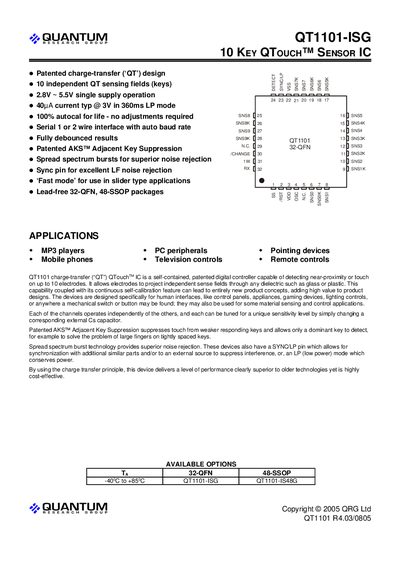
The QT1101‑ISG is a 10‑key QTouch™ sensor IC that uses Quantum’s patented charge‑transfer principle to detect near‑proximity or touch on up to ten independent electrodes. It provides robust operation across a 2.8 V‑5.5 V supply range and includes features such as self‑calibration, adjacent‑key suppression (AKS), spread‑spectrum burst noise rejection, and a low‑power (LP) mode for battery‑operated designs.
The device communicates via a 1‑wire or 2‑wire serial interface with automatic baud‑rate detection, and can be synchronized to an external signal using the SYNC/LP pin. Various option resistors allow configuration of AKS grouping, fast‑detect mode, and maximum on‑duration timeout, making the QT1101‑ISG adaptable to a wide range of human‑interface applications such as control panels, appliances, gaming devices, and lighting controls.
| Supply voltage | 2.8 V – 5.5 V |
|---|---|
| Typical current in LP mode | 40 µA @ 3 V |
| Startup time | 450 ms |
| Self‑calibration time | 450 ms typical |
| Number of keys | 10 independent sensing fields |
| Operating temperature range | -40 °C to +85 °C |
| Package options | Lead‑free 32‑QFN, 48‑SSOP |
| LP mode response times | 120 ms, 200 ms, 360 ms |
It requires about 450 ms to initialize, calibrate and start normal operation.
The device operates from 2.8 V up to 5.5 V single‑supply.
It can detect up to ten independent QT sensing fields (keys).
LP mode provides microamp current consumption with selectable response times of 120 ms, 200 ms, or 360 ms, and the device returns to normal speed after a touch is detected.