
The QT1100A-ISG is an advanced 10-key QTOUCH™ sensor IC suitable for applications such as appliance controls, pointing devices, gaming machines, PC peripherals, television controls, and instrument panels. This device allows each electrode to project an independent sense field through glass or plastic. It is designed specifically for human interfaces, such as control panels, appliances, gaming devices, lighting controls, or anywhere a mechanical switch may be found. Each key channel operates independently and can be tuned to a unique sensitivity level by changing setup values in an EEPROM or via a serial interface. It includes patent pending AKS™ Adjacent Key Suppression, which suppresses touch from weakly responding keys and allows only a dominant key to detect, solving the problem of large fingers on tightly spaced keys. Modulated burst technology provides superior noise rejection. 'Fast-DI' operation works to further suppress false activations due to noise. These devices also have a Sync pin to suppress some forms of external interference.
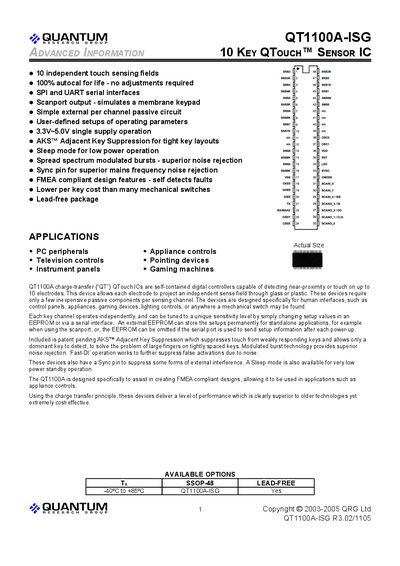
The QT1100A-ISG is a 10‑key touch‑sensor IC that uses Quantum’s patented charge‑transfer technology. It offers independent sensing fields, self‑calibration, adjacent‑key suppression, and low‑power sleep mode for robust human‑interface applications such as appliance controls, gaming devices, and lighting panels.
The document includes wiring diagrams, pin‑list tables for UART, SPI and Scanport interfaces, setup block functions, absolute maximum specifications, recommended operating conditions, and an appendix with the CRC algorithm used for error detection.
| Supply voltage | 3.3 V to 5.0 V |
|---|---|
| Operating temperature range | -40 °C to +85 °C |
| Resonator frequency | 12 MHz |
| Number of touch keys | 10 |
| Serial interfaces | SPI, UART |
It supports up to 10 independent touch sensing fields.
The device operates from a single supply of 3.3 V to 5.0 V.
Yes, a Sleep mode is available for microamp‑level current drain when the device is idle.
The Sync pin allows the device to synchronize to an external source, such as mains frequency, to reduce interference.