
The USBN9603/4 are integrated USB Node controllers with enhanced DMA support. They are compatible with USB specification versions 1.0 and 1.1, and are advanced versions of the USBN9602. The devices integrate the required USB transceiver, a 3.3V regulator, a Serial Interface Engine (SIE), USB endpoint (EP) FIFOs, a versatile 8-bit parallel interface, a clock generator, and a MICROWIRE/PLUS™ interface. Seven endpoint pipes are supported: one for the mandatory control endpoint and six to support interrupt, bulk, and isochronous endpoints. Each endpoint pipe has a dedicated FIFO, 8 bytes for the control endpoint and 64 bytes for the other endpoints. The 8-bit parallel interface supports multiplexed and non-multiplexed style CPU address/data buses. A programmable interrupt output scheme allows device configuration for different interrupt signaling requirements.
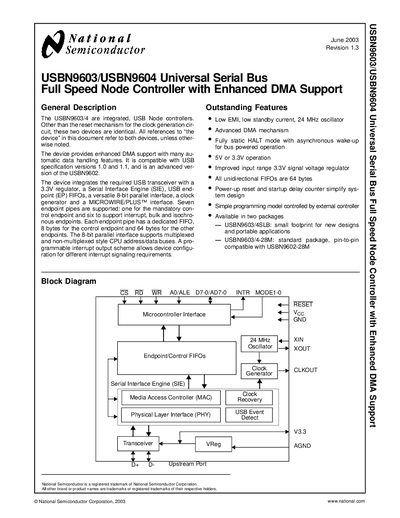
The USBN9603 and USBN9604 are integrated full‑speed USB node controllers featuring low EMI, low standby current, a 24 MHz oscillator, and an on‑chip 3.3 V regulator. They include a Serial Interface Engine, MICROWIRE/PLUS interface, and seven FIFO‑based endpoint pipes (one 8‑byte control endpoint and six 64‑byte data endpoints).\n\nThis handbook covers signal and pin connections, detailed functional overviews, parallel interface modes, DMA operation (standard and automatic), register definitions, device characteristics, absolute maximum ratings, and physical dimensions for both the 28‑pin CSP (SLB) and 28‑pin QFN (M28B) packages.
| Oscillator Frequency | 24 MHz |
|---|---|
| Number of Endpoints | 7 FIFO‑based endpoints (1 control, 6 data) |
| Interface Modes | Non‑multiplexed, Multiplexed (Intel compatible), MICROWIRE |
The device uses a 24 MHz crystal oscillator, with an internal 48 MHz clock generation circuit.
It provides seven FIFO‑based endpoints: one 8‑byte control endpoint and six 64‑byte data endpoints.