
The AD5066 is a low power, 16-bit quad-channel, unbuffered voltage output nanoDAC® offering relative ac, digital gain and offset adjustment, and programmable voltage and current sources.
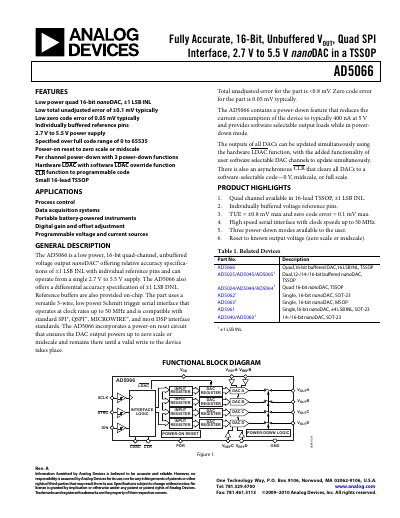
The AD5066 nano‑DAC from Analog Devices provides four independent 16‑bit voltage outputs without internal buffering. It operates from a single 2.7 V to 5.5 V supply and features a high‑speed 50 MHz serial interface compatible with SPI, QSPI, and Microwire standards. The device includes individual reference pins, power‑on reset to zero or mid‑scale, and three selectable power‑down modes.
Typical applications include process control, data‑acquisition systems, portable battery‑powered instruments, and programmable voltage or current sources. The datasheet details functional block diagrams, pin configurations, timing diagrams, and extensive performance specifications such as INL, DNL, gain error, and power consumption.
| Resolution | 16 bits |
|---|---|
| Supply Voltage (VDD) | 2.7 V to 5.5 V |
| Maximum Serial Clock Frequency | 50 MHz |
The AD5066 operates from 2.7 V to 5.5 V.
It provides four independent (quad) output channels.
The serial interface can run up to 50 MHz.