
The document describes the features and characteristics of the AD5025/AD5045/AD5065 products, including low power, dual 12-/14-/16-bit DAC, voltage reference pins, rail-to-rail operation, etc.
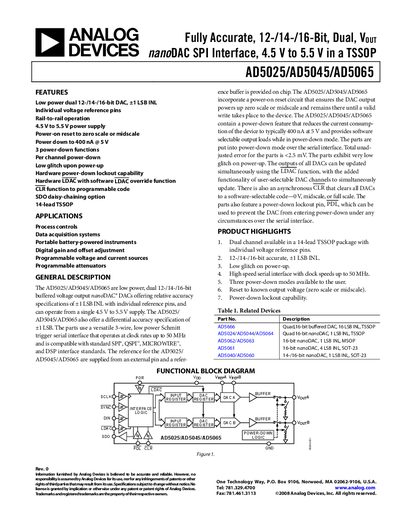
The AD5025, AD5045, and AD5065 are low‑power, dual‑channel nanoDACs offering 12‑, 14‑, or 16‑bit resolution with +1 LSB INL. They operate from a single 4.5 V to 5.5 V supply, feature individual voltage reference pins, rail‑to‑rail output, and multiple power‑down modes.
The document lists detailed electrical specifications, timing characteristics, absolute maximum ratings, pin functions, and application notes such as process control, data acquisition, and portable instruments. It also includes functional block diagrams, revision history, and ordering information.
| Supply voltage range | 4.5 V to 5.5 V |
|---|---|
| Resolution | AD5065 16 bits, AD5045 14 bits, AD5025 12 bits |
| Power‑down current | ≈400 nA at 5 V |
| Maximum SCLK frequency | 50 MHz |
The devices operate from a single 4.5 V to 5.5 V supply.
Typical power‑down current is about 400 nA at a 5 V supply.
The serial interface can run up to 50 MHz.
Three power‑down modes are provided to the user.