
AD5024/AD5044/AD5064 are low power quad 12-/14-/16-bit DAC, pin compatible and performance upgrade to AD5666.
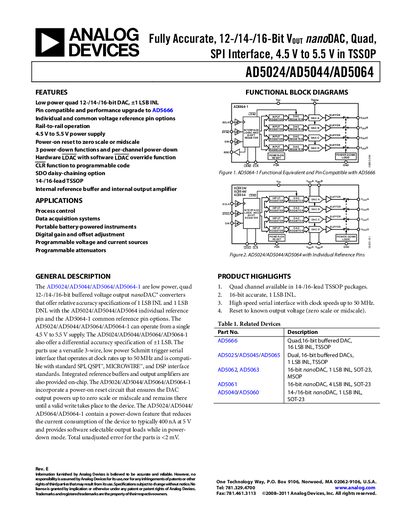
The AD5024/AD5044/AD5064 series are low‑power, quad 12‑/14‑/16‑bit buffered voltage‑output nano‑DACs that operate from a 4.5 V to 5.5 V supply. They feature rail‑to‑rail operation, individual or common reference pins, power‑on reset to zero or mid‑scale, and three power‑down modes. The devices use a 3‑wire SPI‑compatible serial interface capable of up to 50 MHz clock rates and support daisy‑chain operation.
The handbook provides detailed functional block diagrams, pin descriptions, absolute maximum ratings, AC and timing characteristics, and an ordering guide. It also includes application notes such as portable battery‑powered instruments, programmable voltage sources, and digital gain/offset adjustment.
| Resolution | 16 bits (AD5064/AD5064‑1) |
|---|---|
| Supply Voltage Range | 4.5 V to 5.5 V |
| Maximum Serial Clock Frequency | 50 MHz |
| Power‑Down Current Consumption | ≈ 400 nA at 5 V |
| Operating Temperature Range | ‑40 °C to +125 °C |
The devices operate from a single 4.5 V to 5.5 V supply.
The serial clock can run up to 50 MHz.
The AD5064 offers 16‑bit resolution.