
The 74HC123; 74HCT123 high-speed Si-gate CMOS devices are pin compatible with low power Schottky TTL (LSTTL). They are specified in compliance with JEDEC standard no. 7A. The 74HC123; 74HCT123 are dual retriggerable monostable multivibrators with output pulse width control by three methods: 1. The basic pulse time is programmed by selection of an external resistor (REXT) and capacitor (CEXT). 2. Once triggered, the basic output pulse width may be extended by retriggering the gated active LOW-going edge input (nA) or the active HIGH-going edge input (nB). By repeating this process, the output pulse period (nQ = HIGH, nQ = LOW) can be made as long as desired. Alternatively an output delay can be terminated at any time by a LOW-going edge on input nRD, which also inhibits the triggering. 3. An internal connection from nRD to the input gates makes it possible to trigger the circuit by a HIGH-going signal at input nRD as shown in the function table. Schmitt-trigger action in the nA and nB inputs, makes the circuit highly tolerant to slower input rise and fall times. The 74HC123; 74HCT123 is identical to the 74HC423; 74HCT423 but can be triggered via the reset input.
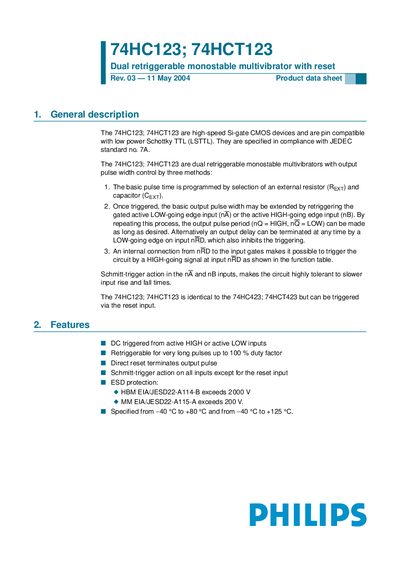
The Philips 74HC123 and 74HCT123 are high‑speed CMOS dual retriggerable monostable multivibrators with reset. They provide programmable pulse widths via external resistor and capacitor networks and support both edge‑triggered and reset‑controlled operation.
The document contains a quick reference table, ordering information, functional diagrams, pin descriptions, electrical characteristics, recommended operating conditions and package options (DIP16, SO16, SSOP16, TSSOP16).
| Supply voltage (Voc) range | 2.0 V – 6.0 V |
|---|---|
| Input capacitance (Ci) | 3.5 pF |
| Power dissipation (Cpp) | ≈54 mW (HC) / 56 mW (HCT) |
| Operating temperature range | -40 °C to +125 °C |
The basic pulse time is set by selecting an external resistor (Rext) and capacitor (Cext).
nRD provides a direct reset and can also trigger the circuit with a HIGH‑going signal.
The supply voltage (Voc) can range from 2.0 V to 6.0 V.