
The LM4890 is an audio power amplifier primarily designed for demanding applications in mobile phones and other portable communication device applications. It is capable of delivering 1 watt of continuous average power to an 8Ω BTL load with less than 1% distortion (THD+N) from a 5VDC power supply.
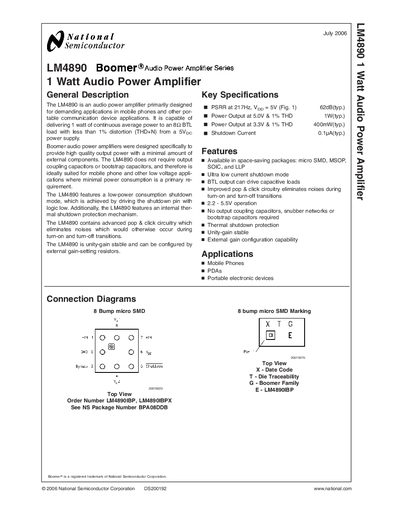
The LM4890 is a 1‑watt audio power amplifier designed for mobile phones and other portable communication devices. It delivers continuous average power to an 8 Ω BTL load with less than 1 % THD+N and includes built‑in pop‑and‑click circuitry, internal thermal shutdown, and an ultra‑low‑current shutdown mode.
The device is offered in space‑saving packages such as micro‑SMD, MSOP, SOIC, and LLP, and can operate from 2.2 V to 5.5 V without external output coupling or bootstrap capacitors. Typical applications include mobile phones, PDAs, and other portable electronics.
| Output Power (5 V, 1 % THD) | 1 W |
|---|---|
| Output Power (3.3 V, 1 % THD) | 400 mW |
| Shutdown Current | 0.1 pA (typ.) |
| Supply Voltage Range | 2.2 V – 5.5 V |
The LM4890 has a typical shutdown current of 0.1 pA.
It operates from 2.2 V up to 5.5 V.
At 5 V it can deliver 1 W into an 8 Ω load with less than 1 % THD.