
The BB149A is a planar technology variable capacitance diode from Philips, in a SOD323 very small plastic SMD package. It has very good linearity and excellent matching performance, and can be used for electronic tuning and VCO.
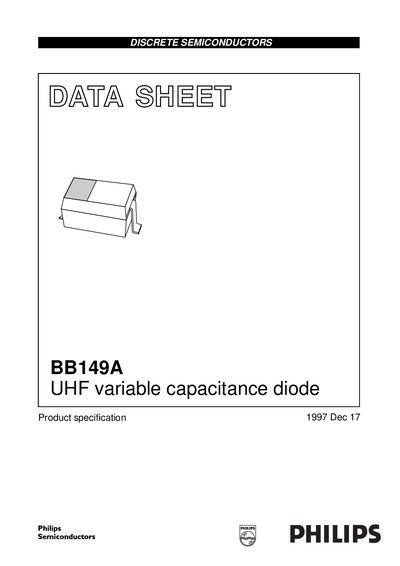
The BB149A is a planar‑technology UHF variable capacitance diode offered by Philips Semiconductors. It features excellent linearity, low series resistance, and a very small SOD323 surface‑mount package, making it suitable for electronic tuning in UHF television tuners and voltage‑controlled oscillators.
Key specifications include a continuous reverse voltage of 30 V, peak reverse voltage of 35 V with a 10 kΩ series resistor, continuous forward current of 20 mA, and operating temperature range from –55 °C to +125 °C. The diode provides a capacitance of about 18–21 pF at 1 V reverse bias and 1 MHz, with a matching tolerance of 2 %.
| Continuous reverse voltage (Ve) | 30 V |
|---|---|
| Peak reverse voltage (VRp) with 10 kΩ resistor | 35 V |
| Storage temperature range (Tstg) | -55 °C to +150 °C |
| Operating junction temperature (Tj) | -55 °C to +125 °C |
| Reverse current (IR) at 30 V | 10 nA typical |
| Reverse current (Vr) at 85 °C | 200 nA |
The BB149A is supplied in a very small plastic surface‑mount package, SOD323, with two leads.
Yes, the storage temperature range is from –55 °C to +150 °C.
No, the BB149A is not designed for life‑support applications; use in such systems is at the customer's own risk.