
AD5253/AD5254 are quad 64/256-position I2C® nonvolatile memory digital potentiometers that can operate on single- or dual-supply voltages.
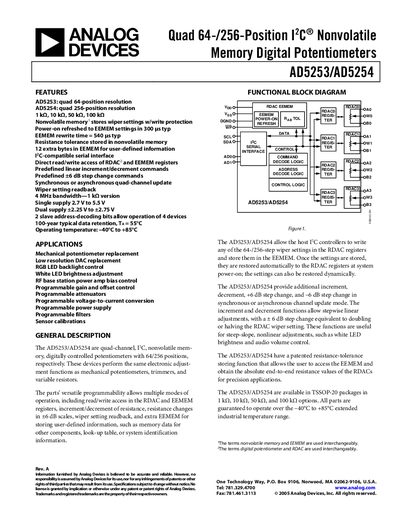
The AD5253 and AD5254 are quad‑channel, non‑volatile memory digital potentiometers offering 64‑position (AD5253) or 256‑position (AD5254) resolution. They provide I²C‑compatible serial interfaces, programmable wiper settings, and optional user‑defined EEPROM storage for system identification or lookup tables.
The document lists detailed electrical specifications, timing characteristics, absolute maximum ratings, and recommended layout guidelines. It also describes typical applications such as mechanical potentiometer replacement, LED backlight control, and programmable gain or offset circuits.
| Resolution (AD5253) | 6 bits |
|---|---|
| Resolution (AD5254) | 8 bits |
| Operating temperature range | -40 °C to +85 °C |
| Data retention (non‑volatile memory) | 100 years (typical) |
The AD5253 provides 6‑bit resolution, while the AD5254 provides 8‑bit resolution.
Both parts are rated for operation from –40 °C up to +85 °C.
The memory can retain data for up to 100 years under typical conditions (55 °C).