
INA116 is an ultra low input bias current instrumentation amplifier produced by Burr-Brown Corporation. It has extremely low input bias current and high common-mode rejection ratio.
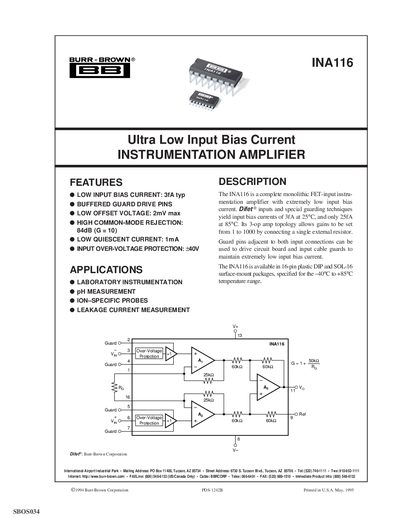
This datasheet describes the INA116, an ultra‑low input bias current instrumentation amplifier with FET inputs. It lists key features such as 3 fA typical input bias current, 2 mV maximum offset voltage, 84 dB common‑mode rejection at a gain of 10, and low 1 mA quiescent current. The device is offered in 16‑pin DIP and 16‑pin surface‑mount packages and operates from –40 °C to +85 °C.
The document includes detailed specifications, pin‑out diagrams, typical performance curves, and application notes on gain setting, offset trimming, input bias current return paths, and PCB layout techniques. An addendum provides package status and ordering information from Texas Instruments, the current owner of the Burr‑Brown product line.
| Input bias current | 3 fA typ |
|---|---|
| Input offset voltage | 2 mV max |
| Common‑mode rejection ratio (G=10) | 84 dB |
| Quiescent current | 1 mA |
| Input over‑voltage protection | +40 V |
| Operating temperature range | -40 °C to +85 °C |
| Differential input impedance | >10^15 Ω |
The INA116 has a typical input bias current of 3 fA.
Gain is set by connecting a single external resistor Rg; the gain equation is 1 + (50 kΩ / Rg).
The device provides a common‑mode rejection of 84 dB at a gain of 10.