
This document introduces the product features, characteristics and applications of PhotoMOS relays
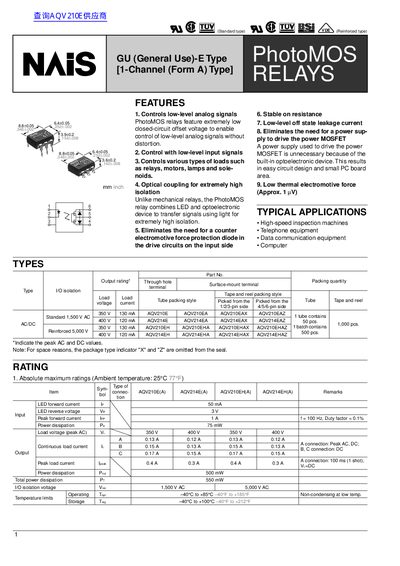
The NAIS PhotoMOS relays are optically coupled devices that control low‑level analog signals with extremely low offset voltage and high isolation. They can switch various loads such as relays, motors, lamps and solenoids without needing a separate power supply for the MOSFET.
The datasheet provides absolute maximum ratings, detailed electrical characteristics, and performance graphs for the AQV210E and AQV214E series, covering load voltage, current, isolation, LED drive requirements, and temperature limits.
| Maximum load voltage (peak AC) | 350 V |
|---|---|
| Maximum load current | 130 mA |
| Isolation voltage (standard type) | 1,500 V AC |
| LED forward current (standard type) | 5 mA |
| LED forward current (reinforced type) | 5‑10 mA |
| Power dissipation (input) | 75 mW |
| Power dissipation (output) | 500 mW |
The maximum load voltage (peak AC) is 350 V.
A forward current of 5 mA is recommended for the standard type.