
The MAX4886 is a high-speed analog switch from ADI that is ideal for HDMI/DVI switching applications. It contains four differential pairs of 1:2 or 2:1 switches for RGB and clocking signals. The MAX4886 can connect one monitor to one of two digital video signals, or one HDMI/DVI source to one of two loads (sinks). The MAX4886 is based on an nFET architecture with internal charge pump for gate overdrive. This advanced architecture results in an extremely low capacitance and on-resistance needed for the excellent return loss requirements for digital switching. An efficient internal charge-pump design offers very low quiescent current for power-sensitive notebook designs. The MAX4886 features 8Ω (typ) on-resistance and 2.5pF on-capacitance switches for routing RGB and CLK video signals. The MAX4886 is a high-frequency companion device to the MAX4929. These two devices combined perform the full 2:1 HDMI/DVI switching function. The MAX4886 is available in a space-saving, 42-pin, 3.5mm x 9.0mm TQFN package and operates over the extended -40°C to +85°C temperature range.
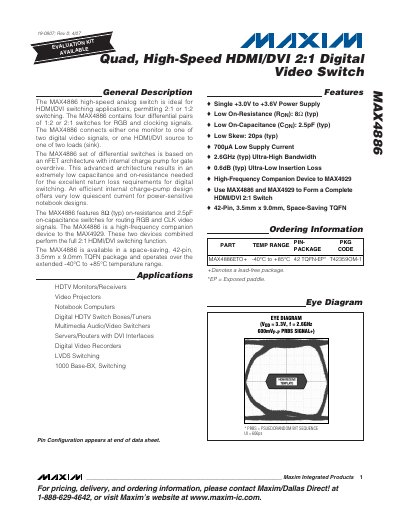
The MAX4886 is a high‑speed analog switch designed for HDMI/DVI 2:1 or 1:2 switching. It contains four differential pairs that route RGB and clock signals and is built on an nFET architecture with an internal charge pump for low on‑resistance and capacitance. The device operates from –40 °C to +85 °C and is supplied in a 42‑pin thin‑QFN package.
The datasheet provides absolute maximum ratings, electrical characteristics, pin descriptions, PCB layout recommendations, timing diagrams, and typical application circuits. It also includes package information and ordering details for designers integrating the MAX4886 into video switching systems.
| On‑Resistance (typical) | 8 Ω |
|---|---|
| Supply Voltage Range | 3.0 V to 3.6 V |
| Bandwidth (‑3 dB) | 2.6 GHz (typ) |
| Insertion Loss (typ) | 0.6 dB |
| Skew (typ) | 20 ps |
| Operating Temperature Range | -40 °C to +85 °C |
The typical on‑resistance is 8 Ω.
It operates from 3.0 V to 3.6 V.
The device provides a typical bandwidth of 2.6 GHz.