
The MAX395 is an 8-channel, serially controlled, single-pole/single-throw (SPST) analog switch that offers eight separately controlled switches. The switches conduct equally well in either direction. On-resistance (100Ω max) is matched between switches to 5Ω max and is flat (10Ω max) over the specified signal range. These CMOS devices can operate continuously with dual power supplies ranging from ±2.7V to ±8V or a single supply between +2.7V and +16V. Each switch can handle rail-to-rail analog signals. The off leakage current is only 0.1nA at +25°C or 5nA at +85°C. Upon power-up, all switches are off, and the internal shift registers are reset to zero. The MAX395 is electrically equivalent to two MAX391 quad switches controlled by a serial interface, and is pin compatible with the MAX335. The serial interface is compatible with SPI™/QSPI™ and Microwire™. Functioning as a shift register, it allows data (at DIN) to be clocked in synchronously with the rising edge of clock (SCLK). The shift register’s output (DOUT) enables several MAX395s to be daisy chained. All digital inputs have 0.8V to 2.4V logic thresholds, ensur- ing both TTL- and CMOS-logic compatibility when using ±5V supplies or a single +5V supply.
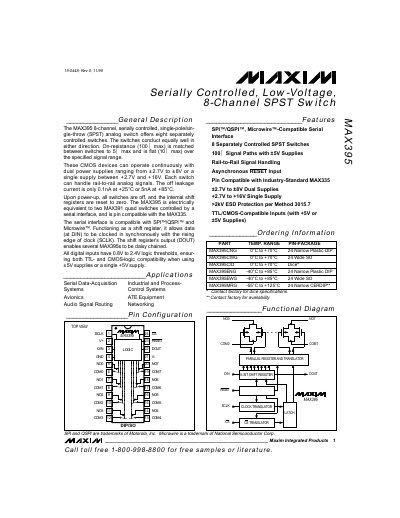
The MAX395 provides eight individually controlled SPST analog switches that operate with dual supplies from ±2.7 V to ±8 V or a single supply from +2.7 V to +16 V. On‑resistance is limited to 100 Ω max (matched to 5 Ω max) and off‑leakage is as low as 0.1 nA at +25 °C. The device functions as a shift register, allowing daisy‑chaining of multiple parts and supporting SPI™, QSPI™ and Microwire™ serial interfaces.
Typical applications include serial data‑acquisition, industrial and process‑control systems, avionics, ATE equipment, audio signal routing and networking. Features such as rail‑to‑rail signal handling, asynchronous reset, and >2 kV ESD protection make the MAX395 suitable for a wide range of low‑voltage switching tasks.