
The MAX9701 stereo Class D audio power amplifier provides Class AB amplifier audio performance with the benefits of Class D efficiency, eliminating the need for a heatsink while extending battery life. The MAX9701 delivers up to 1.3W per channel into an 8Ω load while offering 87% efficiency. Maxim’s next-generation, low-EMI modulation scheme allows the amplifier to operate without an external LC filter while still meeting FCC EMI emission levels. The MAX9701 offers two modulation schemes: a fixed-frequency (FFM) mode, and a spread-spectrum (SSM) mode that reduces EMI-radiated emissions. The MAX9701 oscillator can be synchronized to an external clock through the SYNC input, allowing synchronization of multiple Maxim Class D amplifiers. The sync output (SYNC_OUT) can be used for a master-slave application where more channels are required. The MAX9701 features a fully differential architecture, a full bridge-tied load (BTL) output, and comprehensive click-and-pop suppression. The device features internally set gains of 0dB, 6dB, 12dB, and 18dB selected through two gain-select inputs, further reducing external component count. The MAX9701 features high 80dB PSRR, less than 0.1% THD+N, and SNR in excess of 88dB. Short-circuit and thermal-overload protection prevent the device from being damaged during a fault condition. The MAX9701 is available in 24-pin thin QFN-EP (4mm x 4mm x 0.8mm) and 20-bump UCSP™ (2mm x 2.5mm x 0.6mm) packages.
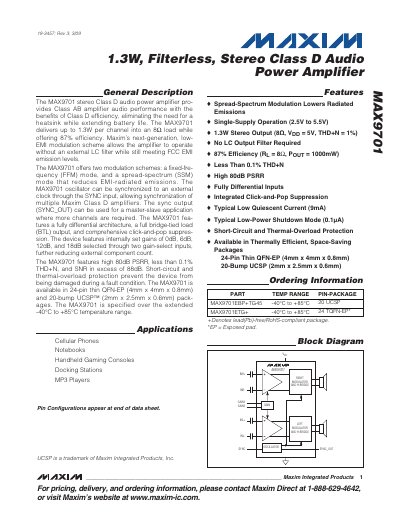
The MAX9701 stereo Class D audio power amplifier provides Class AB audio performance with the efficiency of Class D, eliminating the need for a heatsink and extending battery life. It delivers up to 1.3 W per channel into an 8 Ω load while operating from a single 2.5 V to 5.5 V supply.
The device features a fully differential architecture, BTL output, internal gain settings (0 dB, 6 dB, 12 dB, 18 dB), click‑and‑pop suppression, and protection against short‑circuit and thermal overload. It is offered in 24‑pin thin‑QFN‑EP and 20‑bump UCSP packages and meets FCC EMI limits without an external LC filter.
| Output Power (per channel) | 1.3 W into 8 Ω |
|---|---|
| Efficiency | 87 % |
| Supply Voltage Range | 2.5 V – 5.5 V |
| THD+N | < 0.1 % |
| Power‑Supply Rejection Ratio (PSRR) | 80 dB |
| Signal‑to‑Noise Ratio (SNR) | > 88 dB |
| Gain Settings | 0 dB, 6 dB, 12 dB, 18 dB |
The MAX9701 can deliver up to 1.3 W per channel into an 8 Ω load.
It operates from a single supply of 2.5 V to 5.5 V.
Four internal gain settings are provided: 0 dB, 6 dB, 12 dB, and 18 dB.
The device includes short‑circuit and thermal‑overload protection to prevent damage during fault conditions.