
The MAX9700 is a single-channel D class audio power amplifier that provides class AB amplifier performance with class D efficiency, conserving board space and extending battery life. Using a class D architecture, the MAX9700 delivers 1.2W into an 8Ω load while offering efficiencies above 90%. A low-EMI modulation scheme renders the traditional class D output filter unnecessary. The MAX9700 offers two modulation schemes: a fixed-frequency (FFM) mode, and a spread-spectrum (SSM) mode that reduces EMI-radiated emissions due to the modulation frequency. Furthermore, the MAX9700 oscillator can be synchronized to an external clock through the SYNC input, allowing the switching frequency to be user defined. The SYNC input also allows multiple MAX9700s to be cascaded and frequency locked, minimizing interference due to clock intermodulation. The device utilizes a fully differential architecture, a full-bridged output, and comprehensive click-and-pop suppression. The gain of the MAX9700 is set internally (MAX9700A: 6dB, MAX9700B: 12dB, MAX9700C: 15.6dB, MAX9700D: 20dB), further reducing external component count. The MAX9700 features high 72dB PSRR, a low 0.01% THD+N, and SNR in excess of 90dB. Short-circuit and thermal-overload protection prevent the device from damage during a fault condition. The MAX9700 is available in 10-pin TDFN (3mm ✕ 3mm ✕ 0.8mm), 10-pin µMAX®, and 12-bump UCSP™ (1.5mm ✕ 2mm ✕ 0.6mm) packages. The MAX9700 is specified over the extended -40°C to 125°C temperature range.
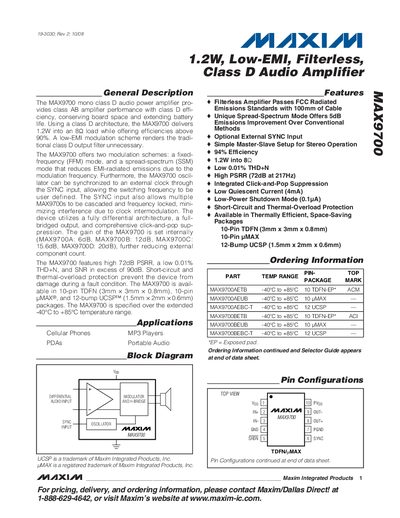
The MAX9700 mono Class D audio power amplifier delivers 1.2 W into an 8 Ω load while providing Class AB performance and efficiencies above 90 %. It features a filter‑less modulation scheme, selectable fixed‑frequency (FFM) or spread‑spectrum (SSM) modes, and an optional external SYNC input for frequency locking and stereo operation. The device is available in compact 10‑pin TDFN, 10‑pin UMAX, and 12‑bump UCSP packages and operates over a temperature range of –40 °C to +85 °C.
Typical specifications include a low 0.01 % THD+N, 72 dB PSRR, short‑circuit and thermal‑overload protection, and a quiescent current of about 4 mA. Detailed pin configurations, absolute maximum ratings, and electrical characteristics are provided for designers.
| Efficiency | ≥90 % (typical 94 %) |
|---|---|
| THD+N | 0.01 % |
| Power‑Supply Rejection Ratio (PSRR) | 72 dB |
The device supports a fixed‑frequency (FFM) mode and a spread‑spectrum (SSM) mode.
An external SYNC input allows the oscillator to be locked to an external clock or to set the frequency for stereo operation.