
The MAX9708 is a single/stereo, Class D audio power amplifier from MAXIM that delivers up to 2 x 21W of output power in stereo mode to an 8Ω load and 1 x 42W of output power in mono mode to a 4Ω load, while offering up to 87% efficiency. The MAX9708 provides Class AB amplifier performance with the benefits of Class D efficiency, eliminating the need for a bulky heatsink and conserving power. The MAX9708 operates from a single +10V to +18V supply, driving the load in a BTL configuration. The MAX9708 offers two modulation schemes: a fixed-frequency modulation (FFM) mode, and a spread-spectrum modulation (SSM) mode that reduces EMI-radiated emissions. The MAX9708 can be synchronized to an external clock from 600kHz to 1.2MHz. A synchronized output allows multiple units to be cascaded in the system. Features include fully differential inputs, comprehensive click-and-pop suppression, and four selectable-gain settings (22dB, 25dB, 29.5dB, and 36dB). A pin-programmable thermal flag provides seven different thermal warning thresholds. Short-circuit and thermal-overload protection prevent the device from being damaged during a fault condition. The MAX9708 is available in 56-pin TQFN (8mm x 8mm x 0.8mm) and 64-pin TQFP (10mm x 10mm x 1.4mm) packages, and is specified over the extended -40°C to +85°C temperature range. Applications include LCD TVs, PDP TVs, Automotive and PC/HiFi Audio Solutions.
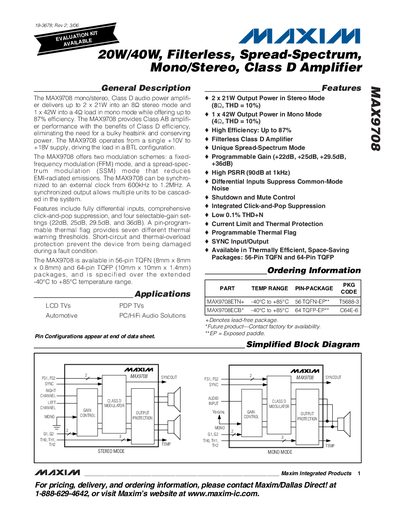
The MAX9708 is a mono/stereo Class D audio power amplifier that operates from a single +10 V to +18 V supply. It provides Class AB‑like performance with up to 87 % efficiency, eliminating the need for a bulky heatsink. The device supports two modulation schemes—fixed‑frequency (FFM) and spread‑spectrum (SSM)—to reduce EMI, and can be synchronized to an external clock from 600 kHz to 1.2 MHz for cascaded operation.
Key features include fully differential inputs, click‑and‑pop suppression, four selectable gain settings (22 dB, 25 dB, 29.5 dB, 36 dB), programmable thermal flag thresholds, and built‑in short‑circuit and thermal‑overload protection. The amplifier is offered in 56‑pin TQFN and 64‑pin TQFP packages and is rated for –40 °C to +85 °C operation.