
The MAX9741 stereo Class D audio power amplifier provides Class AB amplifier performance with Class D efficiency, conserving board space and eliminating the need for a bulky heatsink. Using a high-efficiency Class D architecture, it delivers 12W continuous output power into 8Ω loads. Proprietary modulation and switching schemes render the traditional Class D EMI suppression output filter unnecessary. The MAX9741 offers two modulation schemes: a fixed-frequency mode (FFM), and a spread-spectrum mode (SSM) that reduces EMI-radiated emissions. The device utilizes a fully differential architecture, a full bridged output, and offers comprehensive click-and-pop suppression. The MAX9741 features high 80dB PSRR, low 0.1% THD+N, and SNR in excess of 100dB. Short-circuit and thermal-overload protection prevent the device from being damaged during a fault condition. The MAX9741 is available in a 56-pin TQFN (8mm x 8mm x 0.8mm) package. The MAX9741 is specified over the extended -40°C to +85°C temperature range.
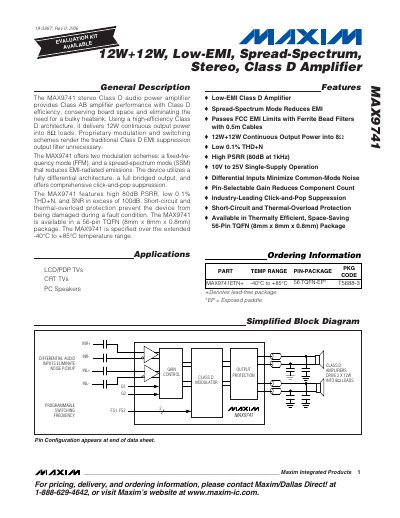
The MAX9741 stereo Class D audio power amplifier provides Class AB performance with Class D efficiency, delivering 12 W continuous output into 8 Ω loads. It features two modulation schemes—fixed‑frequency mode (FFM) and spread‑spectrum mode (SSM)—to reduce EMI emissions, and a fully differential architecture that minimizes common‑mode noise.
The device includes built‑in click‑and‑pop suppression, short‑circuit and thermal‑overload protection, and an internal 6 V linear regulator. It is offered in a 56‑pin TQFN package (8 mm × 8 mm × 0.8 mm) and operates from a 10 V to 25 V supply over –40 °C to +85 °C.
| Continuous Output Power | 12 W per channel into 8 Ω |
|---|---|
| THD+N | 0.1 % |
| Power‑Supply Rejection Ratio (PSRR) | 80 dB |
| Efficiency | > 78 % |
| Operating Temperature Range | -40 °C to +85 °C |
| Package | 56‑pin TQFN (8 mm × 8 mm × 0.8 mm) |
| Input Type | Differential inputs |
| Protection Features | Short‑circuit and thermal‑overload protection |
It supports a fixed‑frequency mode (FFM) and a spread‑spectrum mode (SSM) that reduces EMI‑radiated emissions.
Gain is selectable via the pin‑selectable inputs G1 and G2, allowing multiple gain settings without extra components.