
MAX9736A/B/D is a high-performance, high-efficiency Class D amplifier that can operate from 8V to 28V and provide up to 88% efficiency.
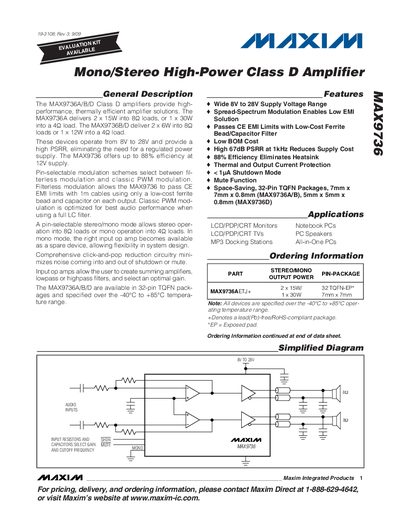
The MAX9736 is a mono/stereo high‑power Class D audio amplifier from Maxim, operating from 8 V to 28 V and delivering up to 30 W output with 88 % efficiency. It offers selectable filter‑less or PWM modulation, a wide supply‑range, and built‑in protection features.
The datasheet provides absolute maximum ratings, detailed electrical characteristics, typical operating graphs, package dimensions for the 32‑pin TQFN variants, ordering information, and a revision history for the A, B, and D versions.
| Supply Voltage Range | 8 V to 28 V |
|---|---|
| Output Power (MAX9736A) | 2 × 15 W into 8 Ω loads or 1 × 30 W into 4 Ω load |
| Efficiency | Up to 88 % at 12 V supply |
| Power‑Supply Rejection Ratio (PSRR) | 67 dB at 1 kHz |
| Package Dimensions (A/B) | 7 mm × 7 mm × 0.8 mm (32‑pin TQFN) |
The device operates from 8 V to 28 V.
It can reach up to 88 % efficiency at a 12 V supply.
Pin‑selectable filter‑less modulation and classic PWM modulation.
A 32‑pin TQFN package in 7 mm × 7 mm × 0.8 mm for A/B variants and 5 mm × 5 mm × 0.8 mm for the D variant.