
The MAX9526 is a low-power video decoder that converts NTSC or PAL composite video signals to 8-bit or 10-bit YCbCr component video compliant with the ITU-R BT.656 standard. The device powers up in fully operational mode and automatically configures itself to decode the detected input standard. The MAX9526 typically consumes 200mW of power in normal operation and typically less than 100µW in shutdown mode. An internal 10-bit, 54MHz analog-to-digital converter (ADC) samples the input with four times oversampling. The MAX9526 features a DC restoration circuit with offset correction and automatic gain control to accurately optimize the full-scale range of the ADC. An integrated analog anti-aliasing filter eliminates the need for external filtering. The MAX9526 includes a 2:1 input multiplexer with automatic signal selection based on activity at the inputs. An internal line-locked phase-locked loop (PLL) generates the sample clock and the line-locked clock (LLC) output to provide an ITU-compliant output. Alternatively, the PLL can be configured to provide a sample clock and output clock at 2x and 1x the frequency of the crystal oscillator, respectively. The MAX9526 provides a multiline adaptive comb filter to reduce cross-chrominance and cross-luminance artifacts. A single 1.8V supply is used for both the digital and analog supplies. The digital outputs operate from a separate +1.7V to +3.45V supply to allow direct connection to a wide range of devices.
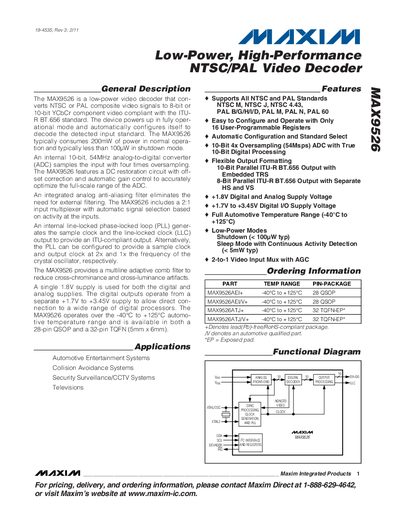
The MAX9526 video decoder converts NTSC or PAL composite video signals to 8‑bit or 10‑bit YCbCr component video compliant with ITU‑R BT.656. It powers up in full‑operational mode, automatically detects the input standard, and offers low‑power operation (≈200 mW normal, <100 µW shutdown). The device includes an integrated anti‑aliasing filter, a 2:1 input multiplexer, and a PLL that can generate sample and line‑locked clocks.
Typical applications include automotive entertainment systems, collision‑avoidance systems, security surveillance, and televisions. The decoder is supplied in 28‑pin QSOP and 32‑pin TQFN (5 mm × 6 mm) packages and operates over –40 °C to +125 °C.
| Typical Power Consumption (normal operation) | 200 mW |
|---|---|
| Shutdown Power Consumption | <100 µW |
| Operating Temperature Range | -40 °C to +125 °C |
| Package Options | 28‑pin QSOP, 32‑pin TQFN (5 mm × 6 mm) |
It supports all NTSC and PAL standards, including NTSC M, NTSC J, NTSC 4.43, PAL B/G/H/I/D, PAL M, PAL N, and PAL 60.
The device typically consumes about 200 mW of power during normal operation.
It operates from –40 °C up to +125 °C, suitable for automotive environments.
The decoder is offered in a 28‑pin QSOP package and a 32‑pin TQFN package (5 mm × 6 mm).