
The MAX4023–MAX4026 family of voltage feedback multiplexer-amplifiers combine low-glitch switching and excellent video specifications with fixed or settable gain. The MAX4024/MAX4026 are triple and quad 2:1 multiplexers, respectively, with amplifiers that have a fixed gain of +2. The MAX4023/MAX4025 are triple and quad 2:1 multiplexers, respectively, with adjustable gain amplifiers optimized for unity-gain stability. All devices have 25ns channel switching time and low 10mVP-P switching transients, making them ideal for high-speed video-switching applications. These devices operate from a single +4.5V to +11V supply or from dual supplies of ±2.25V to ±5.5V, and feature an input common-mode voltage range that extends to the negative supply rail. A low-power disable mode places the output in a high-impedance state. The MAX4023/MAX4025 have -3dB bandwidths of 260MHz and up to 330V/µs slew rates with a settable gain to equalize long cable runs. The MAX4024/ MAX4026, with 200MHz -3dB bandwidths and 363V/µs slew rates, have a fixed gain of +2 for driving short back-terminated cables. The MAX4023/MAX4025 inter- nal amplifiers maintain an open-loop output impedance of only 18Ω over the full output voltage range, and mini- mize the gain error and bandwidth changes under loads typical of most rail-to-rail amplifiers. These devices are ideal for broadcast video applications with differential gain and phase errors of 0.07% and 0.07°, respectively.
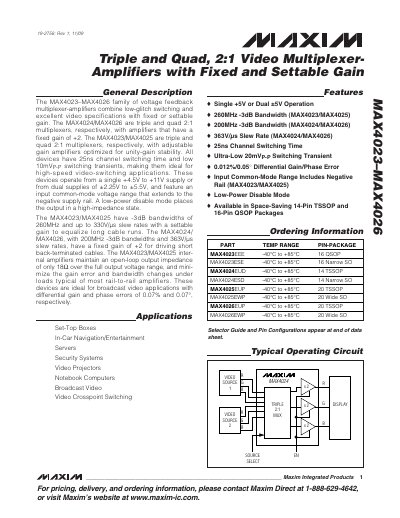
The MAX4023–MAX4026 family are voltage‑feedback multiplexed amplifiers designed for high‑speed video switching. They are available as triple (MAX4023, MAX4025) or quad (MAX4024, MAX4026) 2:1 multiplexers with either fixed (+2) or adjustable gain, and feature low‑glitch switching, low‑power disable mode, and a wide input common‑mode range.
Key specifications include 25 ns channel switching, up to 260 MHz bandwidth (MAX4023/5), 363 V/µs slew rate (MAX4024/6), and differential gain/phase errors as low as 0.012 %/0.07°. The devices operate from a single +4.5 V to +11 V supply or dual ±2.25 V to ±5.5 V supplies and are offered in space‑saving 14‑pin TSSOP and 16‑pin QSOP packages.
| -3 dB Bandwidth (MAX4023/5) | 260 MHz |
|---|---|
| -3 dB Bandwidth (MAX4024/6) | 200 MHz |
| Slew Rate (MAX4024/6) | 363 V/µs |
| Channel Switching Time | 25 ns |
| Differential Gain Error | 0.012 % |
| Input Common‑Mode Range | includes negative rail |
The devices switch channels in 25 ns.
The MAX4024 and MAX4026 have a slew rate of 363 V/µs.
The differential gain error is 0.012 % for the MAX4023/MAX4025 devices.