
The MAX4265~MAX4270 are ultra-low distortion, voltage-feedback op amps capable of driving a 100Ω load while maintaining ultra-low distortion over a wide bandwidth.
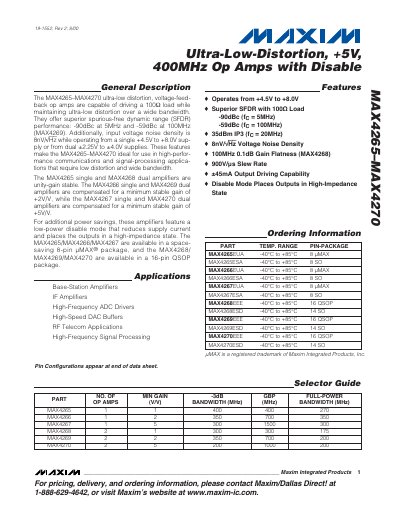
The MAX4265–MAX4270 family are ultra‑low‑distortion, voltage‑feedback operational amplifiers that can drive a 100 Ω load while maintaining low distortion across a wide bandwidth. They are suited for high‑performance communications and signal‑processing applications and are available in both single‑channel (MAX4265, MAX4266, MAX4267) and dual‑channel (MAX4268, MAX4269, MAX4270) versions.
The devices operate from a single +4.5 V to +8.0 V supply (or ±2.25 V to ±4.0 V dual) and feature a low‑power disable mode that places the outputs in a high‑impedance state. Key performance figures include 8 nV/√Hz input voltage noise density, -90 dBc SFDR at 5 MHz, -59 dBc at 100 MHz, and up to 400 MHz -3 dB bandwidth for the MAX4265. They are offered in 8‑pin µMAX and 16‑pin QSOP packages.
| Supply Voltage Range | +4.5 V to +8.0 V (single) or ±2.25 V to ±4.0 V (dual) |
|---|---|
| Input Voltage Noise Density | 8 nV/√Hz |
| Spurious‑Free Dynamic Range (SFDR) | -90 dBc at 5 MHz, -59 dBc at 100 MHz |
| -3 dB Bandwidth (MAX4265) | 400 MHz |
| Output Driving Capability | ±45 mA |
| Disable Mode | Low‑power mode, outputs high‑impedance |
| Package Types | 8‑pin µMAX, 16‑pin QSOP |
The devices operate from +4.5 V to +8.0 V with a single supply, or from ±2.25 V to ±4.0 V with dual supplies.
The input voltage noise density is 8 nV/√Hz.
They achieve -90 dBc at 5 MHz and -59 dBc at 100 MHz.
The series is offered in an 8‑pin µMAX package and a 16‑pin QSOP package.