
The MAX5887 is an advanced, 14-bit, 500Msps digital-to-analog converter (DAC) designed to meet the demanding performance requirements of signal synthesis applications found in wireless base stations and other communications applications.
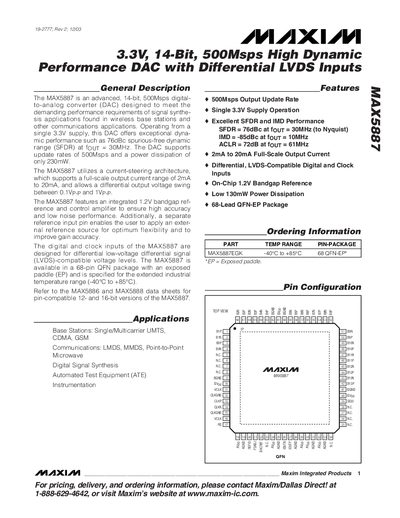
The MAX5887 is a high‑performance, 14‑bit, current‑steering digital‑to‑analog converter (DAC) designed for signal‑synthesis applications such as wireless base stations. It operates from a single 3.3 V supply, offers a full‑scale output current of 2 mA to 20 mA, and dissipates only about 230 mW.
Key features include a 500 Msps output update rate, 76 dBc spurious‑free dynamic range at 30 MHz, and an integrated 1.2 V bandgap reference. The device is supplied in a 68‑lead QFN‑EP package and is rated for –40 °C to +85 °C operation, making it suitable for industrial environments.
| Resolution | 14 Bits |
|---|---|
| Full‑Scale Output Current | 2 mA to 20 mA |
| Power Dissipation | 230 mW |
| Supply Voltage | 3.3 V (single supply) |
| Spurious‑Free Dynamic Range (SFDR) | 76 dBc at 30 MHz |
| Adjacent Channel Leakage Ratio (ACLR) | 72 dB at 61 MHz |
| Package | 68‑lead QFN‑EP |
| Temperature Range | -40 °C to +85 °C |
It operates from a single 3.3 V supply.
The SFDR is 76 dBc at a 30 MHz output frequency.
The device is offered in a 68‑lead QFN‑EP package.