
The INA137 and INA2137 are differential line receivers consisting of high performance op amps with on-chip precision resistors. They are fully specified for high performance audio applications and have excellent ac specifications, including low distortion (0.0005% at 1kHz) and high slew rate (14V/µs), assuring good dynamic response. In addition, wide output voltage swing and high output drive capability allow use in a wide variety of demanding applications. The dual version features completely independent circuitry for lowest crosstalk and freedom from interaction, even when overdriven or overloaded. The INA137 and INA2137 on-chip resistors are laser trimmed for accurate gain and optimum common-mode rejection. Furthermore, excellent TCR tracking of the resistors maintains gain accuracy and common-mode rejection over temperature. Operation is guaranteed from ±4V to ±18V (8V to 36V total supply). The INA137 is available in 8-pin DIP and SO-8 surface-mount packages. The INA2137 comes in 14-pin DIP and SO-14 surface-mount packages. Both are specified for operation over the extended industrial temperature range, –40°C to +85°C.
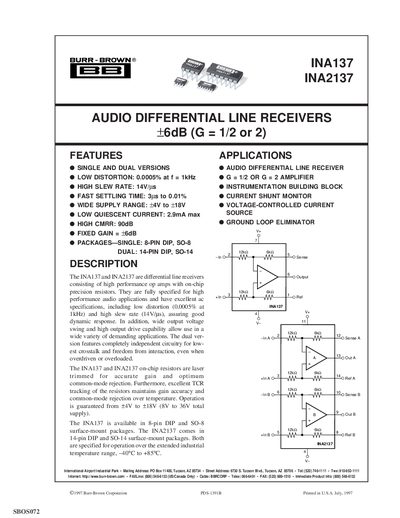
The INA137 and INA2137 are high‑performance audio differential line receivers that provide low distortion, high slew rate, and wide supply voltage operation. They are offered in single‑ended and dual versions with independent circuitry for minimal crosstalk.
Key specifications include a fixed gain of ±6 dB, low distortion of 0.0005 % at 1 kHz, and a supply range of ±4 V to ±18 V. The devices are available in 8‑pin DIP/SO‑8 (INA137) and 14‑pin DIP/SO‑14 (INA2137) packages, with detailed pin‑out and absolute‑maximum ratings provided.
| Gain | ±6 dB (G = 1/2 or 2) |
|---|---|
| Low Distortion | 0.0005 % at 1 kHz |
| Slew Rate | 14 V/µs |
| Supply Voltage Range | ±4 V to ±18 V |
| Quiescent Current | 2.9 mA max per amplifier |
| CMRR | 90 dB |
Both devices have a fixed gain of ±6 dB, selectable as G = 1/2 (‑6 dB) or G = 2 (+6 dB).
They operate from ±4 V up to ±18 V total supply.
Total harmonic distortion is 0.0005 % at 1 kHz, remaining below measurement limits up to about 10 kHz.