
The A6275ELW is a 8-bit serial input, constant current latched LED driver specifically designed for LED display applications. It contains an 8-bit CMOS shift register, accompanying data latches, and eight npn constant-current sink drivers. Except for package style and allowable package power dissipation, the two devices are identical. The CMOS shift register and latches allow direct interfacing with microprocessor-based systems. With a 5 V logic supply, typical serial data-input rates are up to 20 MHz. The LED drive current is determined by the user’s selection of a single resistor. A CMOS serial data output permits cascade connections in applications requiring additional drive lines. For inter-digit blanking, all output drivers can be disabled with an ENABLE input high. Similar 150 mA output devices are available as the A6277EA and A6277ELW; similar 16-bit devices are available as the A6276EA and A6276ELW. Two package styles are provided for through-hole DIP (suffix A) or surface-mount SOIC (suffix LW). Under normal applications, copper lead frames and low logic-power dissipation allow these devices to sink maximum rated current through all outputs continuously over the operating temperature range (90 mA, 0.9 V drop, +85°C).
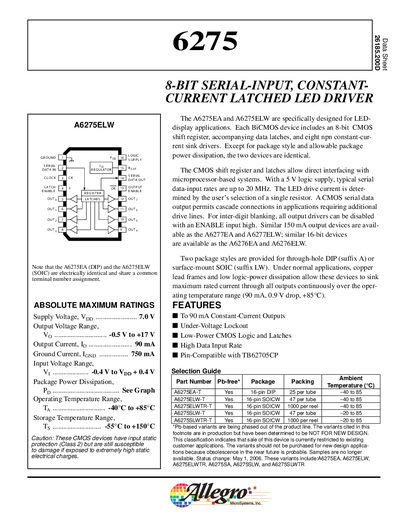
The A6275EA (DIP) and A6275ELW (SOIC) are 8‑bit serial‑input, constant‑current latching LED drivers designed for LED‑display applications. Each device contains a CMOS shift register, data latches, and eight NPN constant‑current sink drivers, with a typical supply voltage of 5 V.
Key features include 90 mA constant‑current outputs, under‑voltage lockout, high data input rates up to 10 MHz, and pin‑compatibility with TB62705CP. The datasheet provides absolute maximum ratings, electrical characteristics, timing requirements, and mechanical dimensions for both package styles.
| Maximum Output Current | 90 mA per output |
|---|---|
| Operating Temperature Range | -40 °C to +85 °C |
| Under‑Voltage Lockout (UVLO) | 3.4 V to 4.0 V |
| Propagation Delay (Clock‑Out) | 350 ns to 1000 ns |
| Output Rise Time (10%‑90%) | 150 ns to 600 ns |
| Output Fall Time (90%‑10%) | 150 ns to 1000 ns |
Each output can source up to 90 mA continuously.
The device operates from –40 °C up to +85 °C.