
TPA701 is a low voltage audio power amplifier developed especially for low-voltage applications where internal speakers are required. Operating with a 3.3-V supply, the TPA701 can deliver 250-mW of continuous power into a BTL 8-Ω load at less than 0.6% THD+N throughout voice band frequencies. Although this device is characterized out to 20 kHz, its operation was optimized for narrower band applications such as wireless communications. The BTL configuration eliminates the need for external coupling capacitors on the output in most applications, which is particularly important for small battery-powered equipment. This device features a shutdown mode for power-sensitive applications with a supply current of 1.5 nA during shutdown. TPA701 is available in an 8-pin SOIC surface-mount package and the surface-mount PowerPAD MSOP, which reduces board space by 50% and height by 40%.
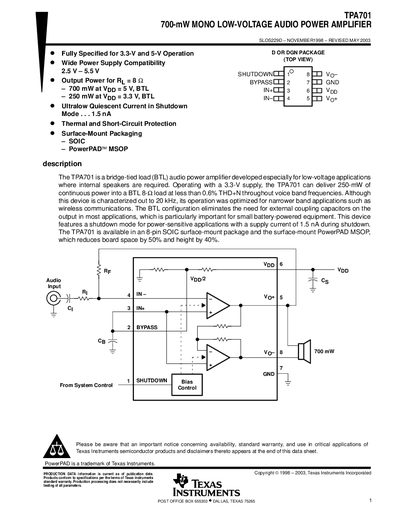
The TPA701 is a bridge‑tied‑load (BTL) audio power amplifier designed for low‑voltage applications that require internal speakers. It delivers up to 700 mW into an 8 Ω load at a 5 V supply (250 mW at 3.3 V) while maintaining low distortion and includes a shutdown mode with ultralow quiescent current.
The device is offered in 8‑pin SOIC and PowerPAD MSOP (D and DGN) packages, with the DGN version supporting continuous 700 mW RMS power. Typical applications include battery‑powered audio equipment and wireless communications where space and power efficiency are critical.
| Supply voltage range | 2.5 V – 5.5 V |
|---|---|
| Output power (5 V supply) | 700 mW into 8 Ω BTL |
| Output power (3.3 V supply) | 250 mW into 8 Ω BTL |
| Shutdown mode quiescent current | 1.5 nA |
| Maximum supply voltage (absolute rating) | 6 V |
| Operating temperature range | -40 °C to 85 °C |
| Package options | 8‑pin SOIC, PowerPAD MSOP (D, DGN) |
The TPA701 operates from 2.5 V to 5.5 V.
It can deliver up to 700 mW into an 8 Ω load in BTL configuration.
The shutdown mode draws only 1.5 nA.
The device is offered in an 8‑pin SOIC package and PowerPAD MSOP (D and DGN) packages.