
TPS6755 is an adjustable inverting dc/dc converter capable of operating from inputs as low as 2.7 V.
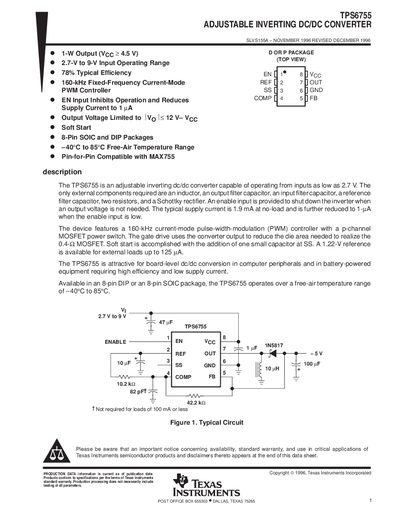
The TPS6755 is an adjustable inverting DC/DC converter that operates from a 2.7 V to 9 V input range and provides up to 12 V output. It features a 160 kHz current‑mode PWM controller, a p‑channel MOSFET power switch, soft‑start, and an enable pin for shutdown, delivering typical efficiencies of 78 % while drawing only 1.9 mA no‑load current.
The device is offered in 8‑pin DIP and SOIC packages and operates over a –40 °C to 85 °C free‑air temperature range. Detailed electrical characteristics, pin descriptions, and application circuits are provided, along with package‑option information and regulatory notices.
| Input operating range | 2.7 V to 9 V |
|---|---|
| Typical efficiency | 78 % |
| Supply current (no‑load) | 1.9 mA |
| Switching frequency | 160 kHz |
| Operating temperature range | ‑40 °C to 85 °C |
| Reference voltage | 1.22 V |
| Package options | 8‑pin DIP or 8‑pin SOIC |
The EN pin enables the converter; a voltage above 2 V turns it on, while a voltage below 0.4 V shuts it down and reduces supply current.
The device typically achieves 78 % efficiency.
The PWM controller operates at a fixed 160 kHz frequency.