
This document is the data sheet for the N2862A passive oscilloscope probe, which describes the characteristics of the probe, including operating temperature, storage temperature, cable length, bandwidth, risetime, attenuation ratio, input resistance, input capacitance, maximum input, and compensation.
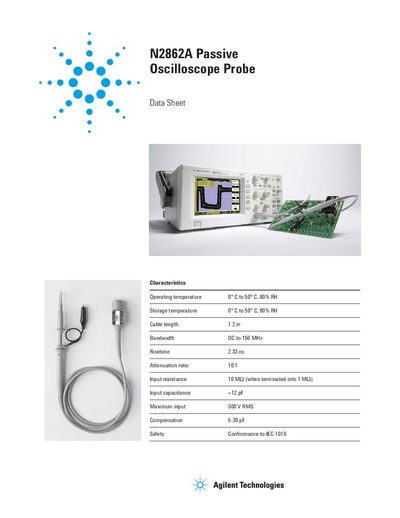
The N2862A is a passive 10:1 attenuation oscilloscope probe designed for high‑frequency measurements. It offers a bandwidth of up to 160 MHz, a risetime of 2.33 ns, and a 12 m cable length, making it suitable for a wide range of test applications.
The datasheet lists key electrical characteristics, temperature limits, and safety compliance, and includes a section on low‑ and high‑frequency compensation procedures. An accessory kit with a retractable hook, adjustment tool, and BNC adapter is also described.
| Operating temperature | 0° C to 0° C, 80% RH |
|---|---|
| Storage temperature | 0° C to 0° C, 80% RH |
| Cable length | 12 m |
| Bandwidth | DC to 160 MHz |
| Risetime | 2.33 ns |
| Attenuation ratio | 10:1 |
| Input resistance | 10 MΩ (when terminated into 1 MΩ) |
| Input capacitance | 12 pF |
| Maximum input voltage | 300 V RMS |
| Compensation range | 5‑30 pF |
| Safety conformance | EC‑1010 |
The probe has a bandwidth from DC up to 160 MHz.
Connect the probe to the oscilloscope, press Autoscale, display a low‑frequency square wave, and adjust the low‑frequency compensation until the pulse is the flattest.
The probe provides a 10:1 attenuation ratio.