
This is a large can type aluminum electrolytic capacitor with high ripple current endurance, low leakage current and low dissipation factor
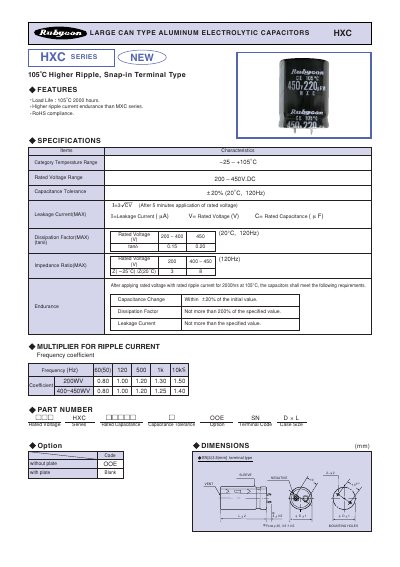
The HXC series capacitors are large‑can type aluminum electrolytic devices with snap‑in terminals, designed for operation up to 105 °C and offering higher ripple‑current endurance than the MXC series. They are RoHS‑compliant and provide a load life of 2000 hours at 105 °C.
Key specifications include a temperature range of –25 °C to +105 °C, rated voltage from 200 V to 450 V DC, capacitance tolerance of +20 % (20 °C, 120 Hz), and defined ripple‑current multipliers for various frequencies. Physical dimensions and case sizes are listed for each capacitance rating. This manual is written in Chinese.
| Temperature Range | -25 °C ~ +105 °C |
|---|---|
| Rated Voltage Range | 200 V ~ 450 V DC |
| Capacitance Tolerance | +20 % (20 °C, 120 Hz) |
| Load Life at 105 °C | 2000 hours |
| Dissipation Factor (max) | ≤ 200 % of specified value |
They operate from –25 °C up to +105 °C.
The rated voltage range is 200 V to 450 V DC.
Capacitance tolerance is +20 % measured at 20 °C and 120 Hz.
They have a load life of 2000 hours at 105 °C.