
The MAX975/MAX977 single/dual comparators feature three different operating modes, and are optimized for +3V and +5V single-supply applications. The operating modes are high speed, high speed with auto-standby, and low power. In high-speed mode, the propagation delay is 28ns, while the supply current is only 250µA. The supply current is reduced to 3µA in low-power mode. The auto-standby feature allows the comparator to automatically change from low-power mode to high-speed mode upon receipt of an input signal. In the absence of an input signal, the comparator reverts back to low-power mode after an adjustable timeout period. The timeout period for the MAX975 to enter standby is set by a single capacitor. The dual MAX977 features independently adjustable timeout periods for each comparator using separate capacitors. The MAX975/MAX977’s inputs have a common-mode voltage range of -0.2V to (VCC - 1.2V). The differential input voltage range extends rail to rail. The outputs are capable of rail-to-rail operation without external pull-up circuitry, making these devices ideal for interface with CMOS/TTL logic. All inputs and outputs can tolerate a continuous short-circuit fault condition to either rail.
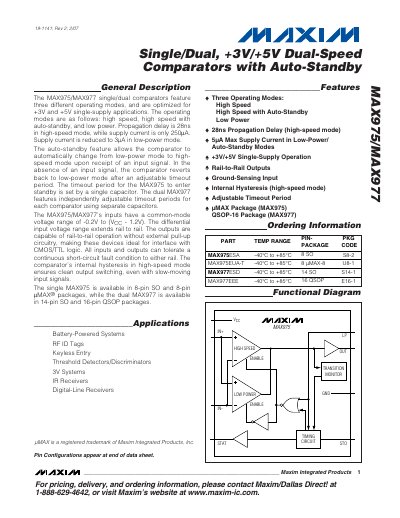
The MAX975 and MAX977 are single‑ and dual‑channel comparators optimized for +3 V and +5 V single‑supply operation. They offer three operating modes—high‑speed, high‑speed with auto‑standby, and low‑power—providing a 28 ns propagation delay in high‑speed mode and a low supply current of 3 µA in low‑power mode.
The devices feature rail‑to‑rail inputs and outputs, internal hysteresis, and an adjustable auto‑standby timeout set by an external capacitor on the STO pin. Available in 8‑pin SO/µMAX and 14‑pin SO/16‑pin QSOP packages, they operate from –40 °C to +85 °C and support a common‑mode voltage range of –0.2 V to (VCC‑1.2 V).
| Propagation delay (high‑speed mode) | 28 ns |
|---|---|
| Supply current (high‑speed mode) | 250 µA |
| Supply current (low‑power mode) | 3 µA |
| Common‑mode voltage range | -0.2 V to (VCC‑1.2 V) |
| Output type | Rail‑to‑rail, no external pull‑up required |
| Supply voltage range | +2.7 V to +5.25 V |
| Operating temperature range | -40 °C to +85 °C |
| Package options | 8‑pin SO, 8‑pin µMAX (MAX975); 14‑pin SO, 16‑pin QSOP (MAX977) |
The high‑speed propagation delay is specified as 28 ns.
In low‑power mode the device draws only 3 µA per comparator.
The common‑mode input range is –0.2 V to (VCC‑1.2 V) and the differential input range extends rail‑to‑rail.