
The MAX941/MAX942/MAX944 are single/dual/quad high-speed comparators optimized for systems powered from a 3V or 5V supply. These devices combine high speed, low power, and rail-to-rail inputs. Propagation delay is 80ns, while supply current is only 350µA per comparator. The input common-mode range of the MAX941/ MAX942/MAX944 extends beyond both power-supply rails. The outputs pull to within 0.4V of either supply rail without external pullup circuitry, making these devices ideal for interface with both CMOS and TTL logic. All input and output pins can tolerate a continuous short- circuit fault condition to either rail. Internal hysteresis ensures clean output switching, even with slow-moving input signals. The MAX941 features latch enable and device shutdown. The single MAX941 and dual MAX942 are offered in a tiny µMAX package. Both the single and dual MAX942 are available in 8-pin DIP and SO packages. The quad MAX944 comes in 14-pin DIP and narrow SO packages.
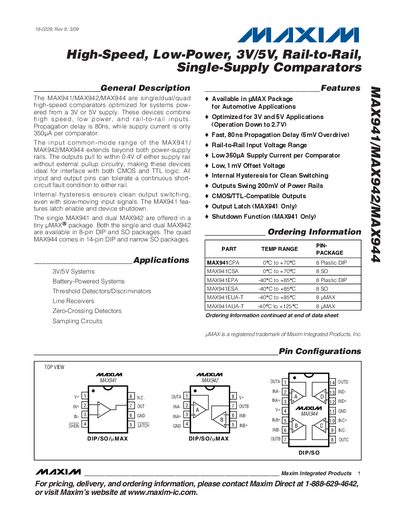
The MAX941, MAX942, and MAX944 are single‑, dual‑, and quad‑channel comparators optimized for 3 V or 5 V systems. They combine high speed (typical 80 ns propagation delay), low supply current (≈350 µA per comparator), and rail‑to‑rail input ranges that extend beyond both supply rails. Features include internal hysteresis, optional output latch (MAX941), and a shutdown mode that reduces current to <60 yA.
The datasheet provides absolute maximum ratings, detailed electrical characteristics, pin configurations for DIP and SO packages, and application guidelines such as layout and decoupling recommendations. Package dimensions and revision history are also included.
| Propagation delay (typical) | 80 ns |
|---|---|
| Supply current per comparator | 350 µA |
| Input common‑mode range | Extends beyond both supply rails |
| Output swing | Within 0.4 V of either rail |
| Input offset voltage | ≤ 1 mV |
| Shutdown current (MAX941) | < 60 yA |
The typical propagation delay is 80 ns.
Each comparator draws about 350 µA of supply current.
In shutdown mode the MAX941 draws less than 60 yA.
Yes, the outputs can swing to within 0.4 V of either rail without external pull‑up circuitry.