
HCPL-7800A/HCPL-7800 Isolation Amplifier Data Sheet
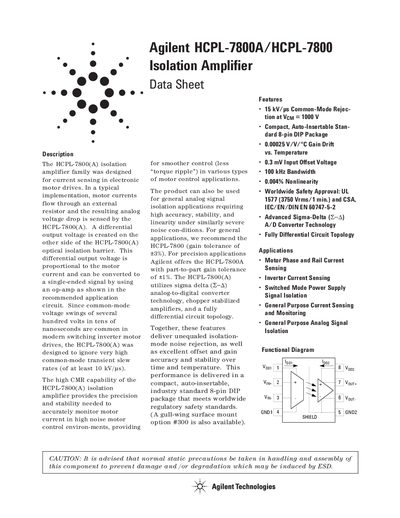
The HCPL-7800(A) isolation amplifier family is designed for current sensing in electronic motor drives and other high‑noise analog signal isolation applications. It converts the voltage drop across an external sense resistor into a differential output that can be further processed by an op‑amp.
Key features include 15 kV/µs common‑mode rejection, low gain drift (0.00025 V/V/°C), 0.3 mV input offset, 100 kHz bandwidth, and UL/CSA safety approvals. The device is offered in a compact 8‑pin DIP package and a gull‑wing surface‑mount option.
| Common-Mode Rejection | 15 kV/µs at Vey = 1000 V |
|---|---|
| Gain Drift vs. Temperature | 0.00025 V/V/°C |
| Input Offset Voltage | 0.3 mV |
| Bandwidth | 100 kHz |
| Operating Temperature Range | -40 °C to 85 °C |
The HCPL-7800(A) is smaller, offers better linearity, lower offset versus temperature, and superior common‑mode rejection compared with most Hall‑effect sensors, and its input‑side supply can be derived from the gate‑drive optocoupler supply.
The device can withstand a momentary (1 minute) voltage of 3750 Vrms per UL 1577 and CSA Component Acceptance.