
APDS-9301 is a light-to-digital ambient light photo sensor that converts light intensity to digital signal output capable of direct I2C interface. It has near infrared and visible light sensing functions, supports 16-bit digital output, supports user-defined upper and lower threshold settings, and can perform precise illuminance measurement under various lighting conditions.
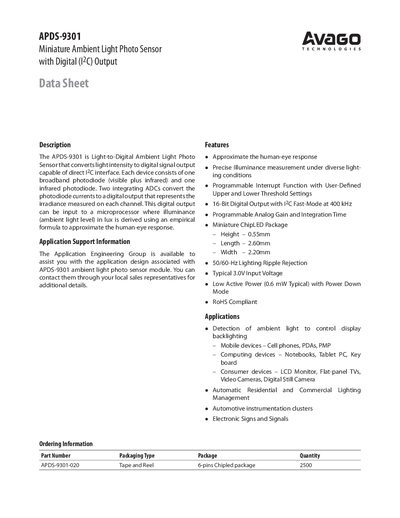
The APDS-9301 is a miniature ambient light photo sensor that converts light intensity to a 16‑bit digital output via an I2C fast‑mode interface. It integrates a broadband photodiode (visible + infrared) and an infrared photodiode, each feeding its own integrating ADC.
The document provides electrical characteristics, pin configuration, register map, application circuit, and mechanical dimensions, enabling designers to integrate the sensor into mobile devices, automotive clusters, and lighting control systems.
| Supply voltage range | 2.7 V – 3.6 V |
|---|---|
| Supply current (active mode) | 0.24 mA typical (0.6 mA max) |
| Operating temperature range | -30 °C – 85 °C |
| Digital output voltage range | -0.5 V – 3.8 V |
| I2C fast‑mode speed | 400 kHz |
| Package dimensions (chip‑LED) | Length 2.60 mm, Width 2.20 mm, Height 0.55 mm |
The sensor offers three 7‑bit slave addresses selectable via the ADDR SEL pin: GND selects 0x49 (0101001), Float selects 0x71 (0111001), and Vpp selects 0x91 (1001001).
Typical active supply current is about 0.24 mA (up to 0.6 mA max).
The chip‑LED package measures 2.60 mm length, 2.20 mm width, and 0.55 mm height.