
The MAX6695/MAX6696 are precise, dual-remote, and local digital temperature sensors. They accurately measure the temperature of their own die and two remote diode-connected transistors, and report the temperature in digital form on a 2-wire serial interface. The MAX6695/MAX6696 can function autonomously with a programmable conversion rate, which allows control of supply current and temperature update rate to match system needs. They measure temperatures from -40°C to +125°C, with a remote temperature sensing accuracy of ±1.5°C between +60°C and +100°C, with no calibration needed. The MAX6695/MAX6696 also include an SMBus timeout feature and two overtemperature limit indicators (OT1 and OT2).
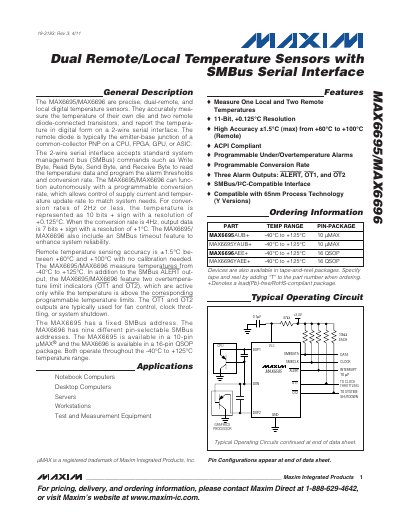
The MAX6695 and MAX6696 are precise dual‑remote and local digital temperature sensors that measure the die temperature and two remote diode‑connected transistors. They communicate via a standard 2‑wire SMBus/I²C‑compatible serial interface and provide programmable alarm thresholds and conversion rates.
The document includes electrical characteristics, absolute maximum ratings, pin descriptions, typical operating circuits, and guidelines for remote‑diode selection, noise filtering, and standby operation. It also lists recommended discrete transistors for remote sensing and provides detailed register maps for SMBus communication.
| Supply Voltage (VCC) | 3.0 – 3.6 V |
|---|---|
| Operating Temperature Range | -40 °C to +125 °C |
| Resolution at ≤2 Hz | 10‑bit + sign, ±0.125 °C |
| Resolution at 4 Hz | 7‑bit + sign, ±1 °C |
| Package Types | MAX6695: 10‑pin μMAX; MAX6696: 16‑pin QSOP |
| Alarm Outputs | ALERT, OT1, OT2 (active‑low) |
They use a standard 2‑wire SMBus/I²C‑compatible serial interface for reading temperature data and writing control bits.
The devices can measure one local temperature and two remote temperatures.
OT1 and OT2 are active‑low outputs that assert when the temperature exceeds their programmed limits.