
The MAX6648/MAX6692 are precise, two-channel digital temperature sensors. They accurately measure the temperature of their own die and a remote PN junction, and report the temperature in digital form using a 2-wire serial interface. The remote PN junction is typically the emitter-base junction of a common-collector PNP on a CPU, FPGA, or ASIC.
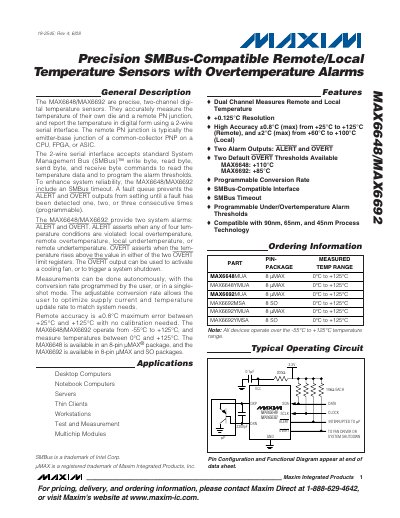
The MAX6648 and MAX6692 are precise, two‑channel digital temperature sensors that measure both the die temperature and a remote PN‑junction temperature. They communicate via a standard SMBus‑compatible two‑wire interface and provide two alarm outputs (ALERT and OVERT) for over‑temperature protection.
The devices operate from –55 °C to +125 °C, support a supply voltage of 3.0 V to 5.5 V, and offer a temperature resolution of 0.125 °C. Features include programmable conversion rates, low‑power standby mode, and built‑in fault‑queue handling. Typical applications are desktop computers, servers, and other systems requiring accurate temperature monitoring.
| Operating Temperature Range | -55 °C to +125 °C |
|---|---|
| Supply Voltage (VCC) | 3.0 V to 5.5 V |
| Standby Supply Current | <10 µA |
It provides two alarm outputs: ALERT and OVERT.
The devices operate with a supply voltage from 3.0 V to 5.5 V.