
The MAX6680/MAX6681 are precise, two-channel digital thermometers that accurately measure the temperature of their own die and one remote PN junction and report the temperature on a 2-wire serial interface. The remote junction can be a diode-connected transistor like the low-cost NPN type 2N3904 or PNP type 2N3906. The remote junction can also be a common-collector PNP, such as a substrate PNP of a microprocessor. The MAX6680/MAX6681 include pin-programmable default temperature thresholds for the OVERT output, which provides fail-safe clock throttling or system shut- down. In addition, the devices are pin programmable to select whether the OVERT output responds to either the local, remote, or both temperatures. The 2-wire serial interface accepts standard System Management Bus (SMBus)™ commands such as Write Byte, Read Byte, Send Byte, and Receive Byte to read the temperature data and program the alarm thresholds and conversion rate. The MAX6680/MAX6681 can func- tion autonomously with a programmable conversion rate, which allows the control of supply current and temperature update rate to match system needs. For conversion rates of 4Hz or less, the remote sensor tem- perature can be represented in extended mode as 10 bits + sign with a resolution of 0.125°C. When the con- version rate is 8Hz, output data is 7 bits + sign with a resolution of 1°C. The MAX6680/MAX6681 also include an SMBus timeout feature to enhance system reliability. The MAX6681 i
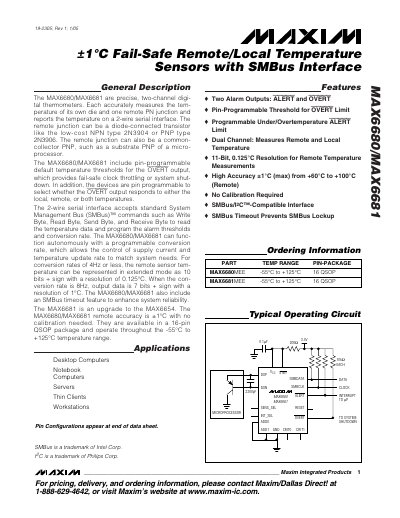
The MAX6680 and MAX6681 are precise two‑channel digital temperature sensors that measure both the die temperature and a remote PN‑junction temperature. They communicate via a 2‑wire SMBus/I²C‑compatible serial interface and provide programmable OVERT and ALERT outputs for fail‑safe thermal management.
The devices are supplied in a 16‑pin QSOP package, operate from –55 °C to +125 °C, and support conversion rates of 4 Hz (extended 0.125 °C resolution) or 8 Hz (legacy 1 °C resolution). Detailed electrical characteristics, pin descriptions, PCB layout recommendations, and low‑power standby operation are included.
| Package | 16‑pin QSOP |
|---|---|
| Operating Temperature Range | -55 °C to +125 °C |
| Resolution (Extended Mode) | 0.125 °C (10‑bit) |
| Resolution (Legacy Mode) | 1 °C (7‑bit) |
| Standby Supply Current | <10 µA |
| Conversion Rate Options | 4 Hz (extended) or 8 Hz (legacy) |
It uses a 2‑wire SMBus/I²C‑compatible serial interface.
The OVERT output can be pin‑programmed to respond to local temperature, remote temperature, or both.
The resolution is 0.125 °C (10‑bit) for conversion rates of 4 Hz or slower.
They operate from –55 °C to +125 °C.