
This document introduces the DS600 temperature sensor, which has an accuracy of ±0.5°C and is suitable for temperatures from -20°C to +100°C.
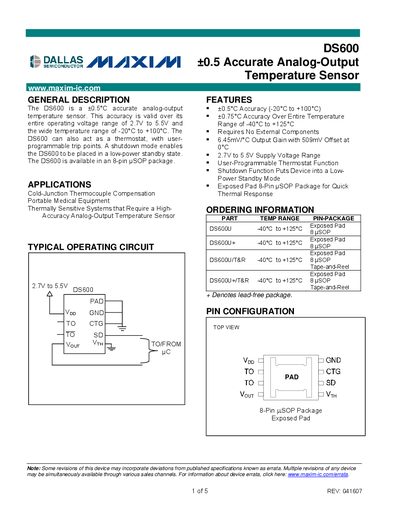
The DS600 is a +0.5°C accurate analog‑output temperature sensor that operates from 2.7 V to 5.5 V and covers –20 °C to +100 °C (±0.5 °C) or –40 °C to +125 °C (±0.75 °C). It is offered in an 8‑pin uSOP package with an exposed pad for fast thermal response. The device can also function as a thermostat with user‑programmable trip points and a shutdown mode for low‑power standby.
The handbook includes absolute maximum ratings, DC electrical characteristics, pin descriptions, typical operating circuits, thermostat operation details, and package dimensions. It provides the necessary specifications for designers to integrate the sensor into cold‑junction compensation, portable medical equipment, and other thermally sensitive systems.
| Accuracy | ±0.5°C (-20°C to +100°C) |
|---|---|
| Supply Voltage | 2.7 V to 5.5 V |
| Operating Temperature Range | -40 °C to +125 °C |
The DS600 operates from 2.7 V to 5.5 V.
It provides ±0.5°C accuracy over the –20 °C to +100 °C range.
Yes, it has a user‑programmable thermostat function with active‑high or active‑low outputs.