
This datasheet introduces the features of TI's DAC7718 chip, including voltage output range, resolution, power consumption, etc.
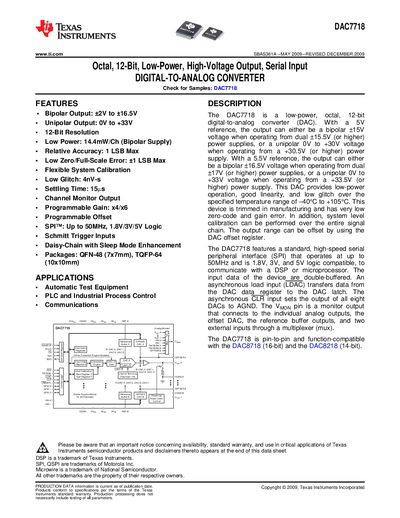
The DAC7718 from Texas Instruments is a 12‑bit, octal digital‑to‑analog converter designed for low‑power, high‑voltage applications. It supports both bipolar (+2 V to +16.5 V) and unipolar (0 V to +33 V) output configurations and offers programmable gain of ×4 or ×6.
The device features a high‑speed SPI interface up to 50 MHz, Schmitt‑trigger inputs, and daisy‑chain capability with sleep‑mode enhancement. It is offered in QFN‑48 and TQFP‑64 packages and includes specifications for absolute maximum ratings, electrical characteristics for dual‑ and single‑supply operation, and mechanical dimensions.
| Resolution | 12 Bits |
|---|---|
| Bipolar Output Range | +2 V to +16.5 V |
| Low Power Consumption | 14.4 mW per channel (bipolar supply) |
| SPI Clock Frequency | Up to 50 MHz |
| Programmable Gain | ×4 or ×6 |
| Settling Time | 151 µs |
| Package Options | QFN‑48 (7 × 7 mm) and TQFP‑64 (10 × 10 mm) |
| Maximum Glitch Energy | 4 nV‑s |
The device’s SPI interface operates up to 50 MHz.
It is offered in a QFN‑48 package (7 × 7 mm) and a TQFP‑64 package (10 × 10 mm).
Each channel consumes 14.4 mW when operated with bipolar supplies.