
APDS-9300 is a small digital ambient light sensor with digital I2C interface, which can convert light intensity to digital signal output.
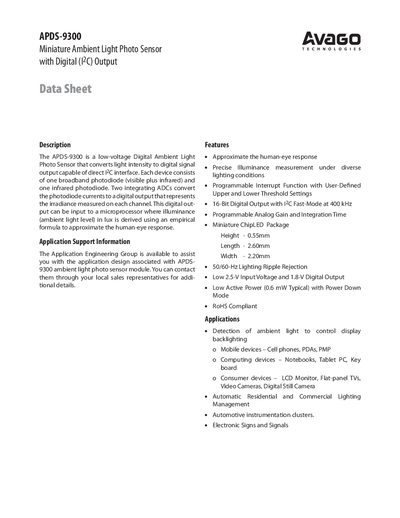
The APDS-9300 is a low‑voltage digital ambient light photo sensor that combines a broadband photodiode and an infrared photodiode. It integrates two ADCs to convert photodiode currents into a 16‑bit digital output, approximating the human‑eye response and offering programmable interrupt thresholds.
The device operates from a 2.5‑V to 3.8‑V supply, consumes as little as 0.6 mA in active mode (0.24 mA typical), and communicates via an I²C fast‑mode interface up to 400 kHz. It is offered in a 6‑pin chip‑LED package (0.55 mm × 2.60 mm × 2.20 mm) and includes three selectable I²C slave addresses via the ADDR SEL pin.
| Supply voltage (max) | 3.8 V |
|---|---|
| Package dimensions | 0.55 mm × 2.60 mm × 2.20 mm |
| I²C fast‑mode speed | 400 kHz |
| Digital output resolution | 16 bits |
| Interrupt function | Programmable upper/lower thresholds |
| Package type | 6‑pin chip‑LED (tape & reel) |
The device offers three 7‑bit slave addresses selectable via the ADDR SEL pin: GND = 0101001, Float = 0111001, Vop = 1001001.
The absolute maximum supply voltage is 3.8 V.
The chip‑LED package measures 0.55 mm high, 2.60 mm long and 2.20 mm wide.