
MAX6691 is a four-channel thermistor temperature-to-pulse-width converter that measures the temperatures of up to four thermistors and converts them to a series of output pulses whose widths are related to the thermistors' temperatures. Each of the four thermistors and an external fixed resistor (REXT) form a voltage-divider that is driven by the MAX6691's internal voltage reference (VREF). VREF and the voltage across REXT are measured and converted to a pulse. The MAX6691 has a single open-drain I/O pin that can be readily connected to a variety of microcontrollers. The microcontroller initiates a conversion by pulling the I/O pin low and releasing it. When conversion is done, the MAX6691 signals the end of conversion by pulling the I/O pin low once again. The pulse corresponding to the first thermistor is sent immediately after the release of the I/O pin. The on-chip power-management circuitry reduces the average thermistor current to minimize errors due to thermistor self-heating. Between conversions, the MAX6691 falls into a 10µA (max) sleep mode, where the voltage reference is disabled and the supply current is at its minimum. The MAX6691 is available in a 10-pin µMAX package and is specified from -55°C to +125°C temperature range.
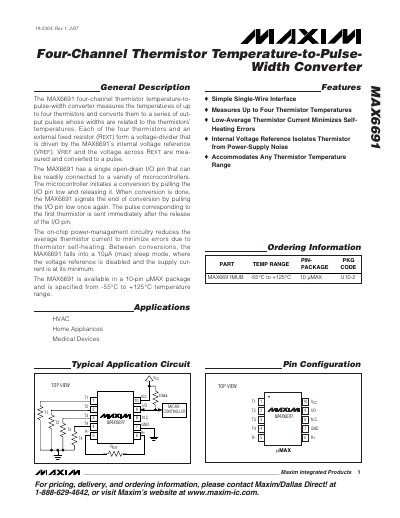
The MAX6691 converts the temperatures of up to four thermistors into pulse‑width‑modulated signals on a single open‑drain I/O pin. It uses an internal voltage reference and an external resistor (R EXT) to form voltage dividers, energizing each thermistor only during measurement to minimize self‑heating.
The device operates from 3.0 V to 5.5 V, supports a temperature range of –55 °C to +125 °C, and enters a low‑power sleep mode (≤10 µA) between conversions. Conversion is initiated by pulling the I/O pin low, and the resulting pulse widths represent the measured temperatures.
| Supply Voltage Range | 3.0 V to 5.5 V |
|---|---|
| Sleep‑Mode Supply Current | 3.5 µA to 10 µA |
| Conversion Time | 86 ms to 156 ms |
| Typical Pulse Width (t LOW) | 4.0 ms to 7.5 ms |
| Operating Temperature Range | -55 °C to +125 °C |
The corresponding T HIGH pulse becomes a short pulse of less than 5 % of T LOW.
The device is rated for a maximum supply voltage of 5.5 V.
In sleep mode the MAX6691 draws between 3.5 µA and 10 µA.