
The MAX3250 is a 3.0V to 5.5V powered, ±50V isolated EIA/TIA-232 and V.28/V.24 communications interface with high data-rate capabilities. It is designed to operate in noisy conditions with high common-mode voltages and prevent damage from short-circuits to power buses. The device is powered by a single 3V to 5.5V supply and has two receivers and two drivers. It can run at data rates of 250kbps while maintaining RS-232 output levels. The MAX3250 is suitable for industrial control applications.
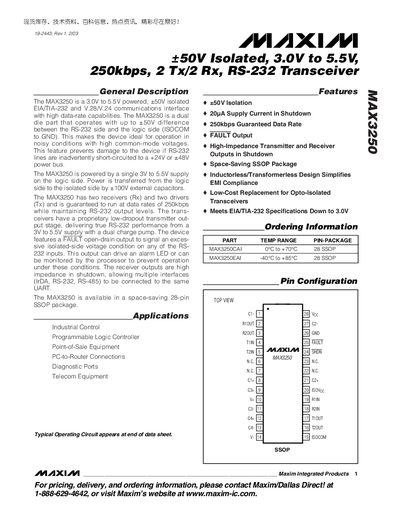
The MAX3250 provides a dual‑die, +50 V isolated EIA/TIA‑232 interface that operates from a single 3 V‑5.5 V supply. It features two transmitters and two receivers, a FAULT open‑drain output, and high‑impedance shutdown mode, making it suitable for noisy industrial environments.
Typical applications include industrial control, PLCs, point‑of‑sale equipment, telecom gear, and diagnostic ports. The device uses an inductor‑less dual charge‑pump architecture and is offered in a space‑saving 28‑pin SSOP package.
| Supply Voltage | 3.0 V to 5.5 V |
|---|---|
| Isolation Voltage | +50 V |
| Number of Tx/Rx Channels | 2 Tx, 2 Rx |
| Package | 28‑pin SSOP |
| FAULT Output | Open‑drain, active‑low |
It provides up to +50 V of isolation between the RS‑232 side and the logic side.
The part is available in a 28‑pin SSOP package.