
The MAX710/MAX711 is a step-up DC-DC converter with a linear regulator integrated to provide step-up/down voltage conversion. They are optimized for battery applications where the input varies above and below the regulated output voltage. They have an input range from +1.8V to +11V. Typical efficiency when boosting battery inputs is 85%. The MAX710/MAX711 can be configured for minimum noise or optimum efficiency. Shutdown control turns off the part completely, disconnecting the input from the output (ISHDN = 0.2µA). Standby control turns off only the step-up converter and leaves the low-power linear regulator active (IQ = 7µA).
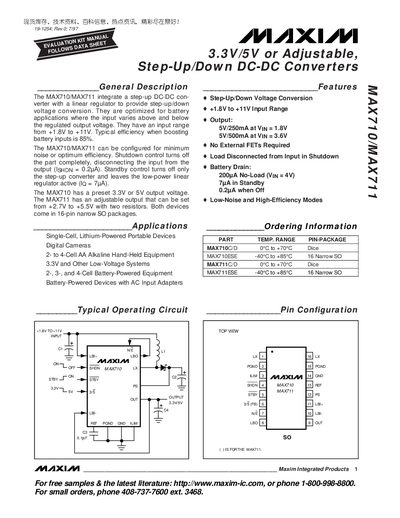
The MAX710/MAX711 integrate a step‑up DC‑DC converter with a linear regulator to provide step‑up/down voltage conversion. They are optimized for battery applications where the input voltage can be above or below the regulated output. The devices operate from an input range of +1.8 V to +11 V and offer high efficiency (typical 85 % in boost mode) while providing low‑noise or high‑efficiency configurations.
The MAX710 provides a fixed 3.3 V or 5 V output, whereas the MAX711 offers an adjustable output from 2.7 V to 5.5 V. Both parts are supplied in 16‑pin narrow SO packages and include shutdown and standby controls that reduce quiescent current to 0.2 µA when off.
| Input voltage range | +1.8 V to +11 V |
|---|---|
| Output voltage (MAX710) | Fixed 3.3 V or 5 V |
| Output voltage (MAX711) | Adjustable 2.7 V to 5.5 V |
| Typical boost efficiency | ≈85 % |
| Shutdown current (ISHDN) | 0.2 µA |
| Maximum output current (5 V version) | 250 mA at VIN = 1.8 V |
| Package | 16‑pin narrow SO |
The devices operate from +1.8 V up to +11 V.
The MAX710 provides a fixed 3.3 V or 5 V output, while the MAX711 offers an adjustable output from 2.7 V to 5.5 V.
The shutdown current is 0.2 µA.
Typical boost efficiency is about 85 %.