
BTA140 series triacs are glass passivated triacs in a plastic envelope, intended for use in applications requiring high bidirectional transient and blocking voltage capability and high thermal cycling performance. Typical applications include motor control, industrial and domestic lighting, current heating and static switching.
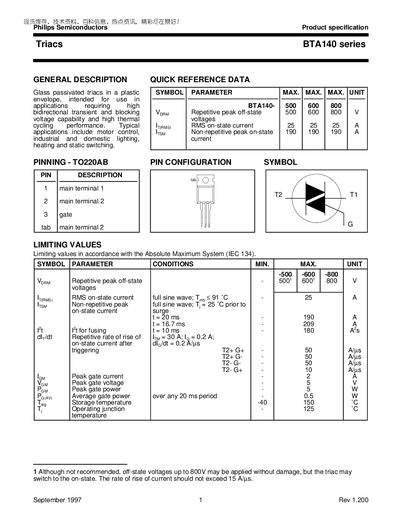
The BTA140 series triacs are glass‑passivated devices in a TO‑220AB package, intended for applications requiring high bidirectional transient and blocking voltage capability and high thermal cycling performance. Typical uses include motor control, industrial and domestic lighting, heating and static switching.
The datasheet lists electrical limits such as a repetitive peak off‑state voltage of 800 V, RMS on‑state current of 25 A, and non‑repetitive peak on‑state current of 190 A. Thermal characteristics include a full‑cycle thermal resistance of 1.0 K/W and a storage temperature range of –40 °C to 150 °C. Mechanical dimensions and pin configuration are also provided.
| Thermal resistance (full cycle) | 1.0 K/W |
|---|---|
| Storage temperature range | -40 °C to 150 °C |
The full‑cycle thermal resistance is 1.0 K/W.
The device can be stored between –40 °C and 150 °C.